
Outside Counsel: How Global Legal Teams Coordinate External Advice | Alf
Outside Counsel: How Global Legal Teams Coordinate External Advice | Alf
TL;DR
Outside counsel are lawyers at an external law firm engaged for advice or representation, as opposed to in-house counsel employed by the organization. International legal teams turn to them for local law, specialist depth, peaks in workload and situations where independence matters. In a group, the difficulty is rarely finding a good firm. It is that advice paid for by one entity stays in one person’s inbox. Give each engagement an owner, a written scope and a shared record of the advice and of the decision taken on it.
In this article
Consider a legal counsel in Madrid who commissions advice on how an EU regulation affects the group’s distribution contracts. Six months later, a colleague in Warsaw pays another firm for the same EU-level analysis, because the first memo never left an inbox. The advice was good. The organization just had no way to know it already existed. This is the coordination problem that matters most when a legal department works across multiple entities and jurisdictions.
What is outside counsel?
Outside counsel is a lawyer or law firm that an organization engages from outside, for a specific matter or on an ongoing basis, rather than employing directly. The term is most common in American English; British usage often prefers “external counsel.” In both cases the meaning is the same: a qualified lawyer who is not an employee of the client and who advises or represents that client under an engagement letter that sets out the scope of the work, the fees and the people involved.
The contrast with in-house counsel is the clearest way to understand the role. In-house counsel are employees who advise the organization from the inside, with full knowledge of its business, its risk appetite and its history. Outside counsel bring what the in-house team does not have: local qualification in a jurisdiction where the group has no lawyer, specialist depth in a practice area needed only occasionally, extra capacity during a transaction or a peak, or the independence that some situations require. Outside counsel remain bound by the professional rules of their bar, including duties of confidentiality and rules on conflicts of interest. In Europe, the CCBE Code of Conduct for European Lawyers sets out these principles for cross-border practice. That independence is part of what a company buys when it instructs a firm, and it also means the firm works from the facts and the question it is given, which puts the responsibility for a good brief squarely on the in-house team.
When should an in-house team use outside counsel?
Use outside counsel when a matter needs something the in-house team does not have. Keep in-house whatever depends on knowing the business, its risk appetite and its history. The table below covers the most common situations for an international legal department and shows what stays inside in each case.
| Situation | Why go outside | What stays in-house |
|---|---|---|
| Local law in a country where you have no lawyer | Qualified local advice and representation | The business question and the final decision |
| Litigation and regulatory proceedings | Procedure, rights of audience, independence | Strategy and settlement authority |
| Specialist topics such as competition, tax or sanctions | Depth that is needed only a few times a year | Applying the advice to operations |
| Transactions and peaks in workload | Capacity for a limited period | Coordination and institutional knowledge |
| Sensitive internal investigations | Independence and, in some jurisdictions, privilege | Governance and follow-up |
Privilege deserves a specific note, because the rules differ from one legal system to another. In EU competition investigations, the Court of Justice held in Akzo Nobel v Commission (Case C-550/07 P, 2010) that legal professional privilege does not cover communications with in-house lawyers. National rules vary, and some countries protect in-house advice under certain conditions. A group that operates in several jurisdictions should therefore decide, topic by topic, when advice needs to come from an external lawyer. That is a question to settle with qualified counsel in each country concerned.
Why does external advice get lost in a group?
External advice gets lost because it is delivered to a person, not to the organization. The memo arrives by email, answers the question of the day and stays in the inbox of whoever asked. Nothing in that sequence tells the Warsaw team that Madrid already has an answer. Nothing records what the company decided to do after reading it.
The consequences compound over time. Two subsidiaries pay for the same analysis, or worse, receive different answers and apply different positions to the same template. A lawyer leaves, and the reasoning behind a clause leaves with them. Months later, someone finds the memo and relies on it without knowing that it assumed facts that have since changed. The issue isn’t the quality of the advice. It’s where the advice ends up.
How to coordinate outside counsel across entities and jurisdictions
Coordinate outside counsel by treating each engagement as shared work with an owner, a scope and a record, rather than a private exchange between one lawyer and one firm. The five practices below cover most of the ground. None of them requires a new panel or a new fee model, and each can be introduced on the next engagement.
Name one owner and write down the scope
Every engagement needs one in-house owner who briefs the firm, receives the advice and answers for the budget. Write the scope in a few lines: the question, the entities and jurisdictions concerned, the facts assumed, the deliverable and the deadline. A written scope is also the reference when the work expands, which is the moment budgets slip. The methods of legal project management apply directly here: named responsibilities, defined deliverables and a clear escalation path when scope changes.
Decide who may instruct a firm
In many groups, any lawyer in any subsidiary can call a firm without a central view of what is being commissioned or what it costs. Setting a rule on who may instruct outside counsel, for which types of matter and above which amount approval is needed from group legal, gives the organization visibility without creating unnecessary friction. A short list of preferred firms per country helps local teams and gives the group a consolidated view of its relationships. The rule should be easy to follow, or people will work around it.
Keep the advice in a shared record, with its conditions
Store each piece of advice with the matter it relates to, not in a personal mailbox. Record the question asked, the facts assumed, the jurisdiction, the date, the firm and the lawyer who signed it. These conditions are what allow a colleague in another entity to judge whether the advice applies to their situation. When the advice shaped a contract, link it from the contract repository so that the reasoning travels with the document rather than staying in a folder no one else can find.
Record the decision, not only the advice
Advice sets out options and risks. The company then chooses, and that choice is the part most often lost. Note what was decided, by whom and why, especially when the business accepted a risk the firm had flagged. The next person who handles the topic needs the decision at least as much as the memo, because the decision is what the organization actually acted on.
Check before reusing advice in another entity
Advice is tied to a jurisdiction, a date and a set of facts. Before another subsidiary relies on it, confirm whether the law is the same there and whether anything has changed since the advice was given. Ask the firm whether sharing the document within the group affects confidentiality or privilege, since the answer depends on the jurisdiction. Restrict access to sensitive advice to the people who need it, and if the facts differ materially, ask for an update rather than stretching the original.
Is external advice scattered across inboxes in your group? Map one real engagement with the Alf team, from the first brief to the recorded decision, entity by entity.
Talk to an expertHow should fees be framed?
Fees should be agreed in writing before work starts and tied to the matter and to the entity that will bear them. That link is what makes external spend readable at group level, whatever the fee model chosen. Hourly billing suits work whose scope is hard to predict at the outset. Fixed or capped fees suit work that can be scoped in advance, and they shift the risk of scope creep to the firm rather than the client.
Billing guidelines help when they are short and applied consistently. They typically state who may work on the matter, what counts as a billable expense and how invoices must be presented. An approval step before an invoice is paid, routed to the engagement owner, catches most surprises before they reach the finance team. The person who sets and maintains these rules is usually the legal operations manager, in agreement with the General Counsel and finance. Fees are a section of the outside counsel relationship, not the whole of it: the deeper question is always whether the advice reached the people who needed it and whether the decision taken on it is recorded.
The coordination principle
A collection of tools is not an operating model. External advice has value to the group only when its entity, its jurisdiction, its owner and the decision taken on it are recorded alongside it. Without that structure, the same question gets answered twice, positions diverge across subsidiaries and knowledge walks out the door when a lawyer changes role.
The five practices above do not require a new panel or a new system to start. They require a decision that each engagement is organizational work, not a private exchange, and that the record of it belongs to the group.
How Alf helps keep external advice in context
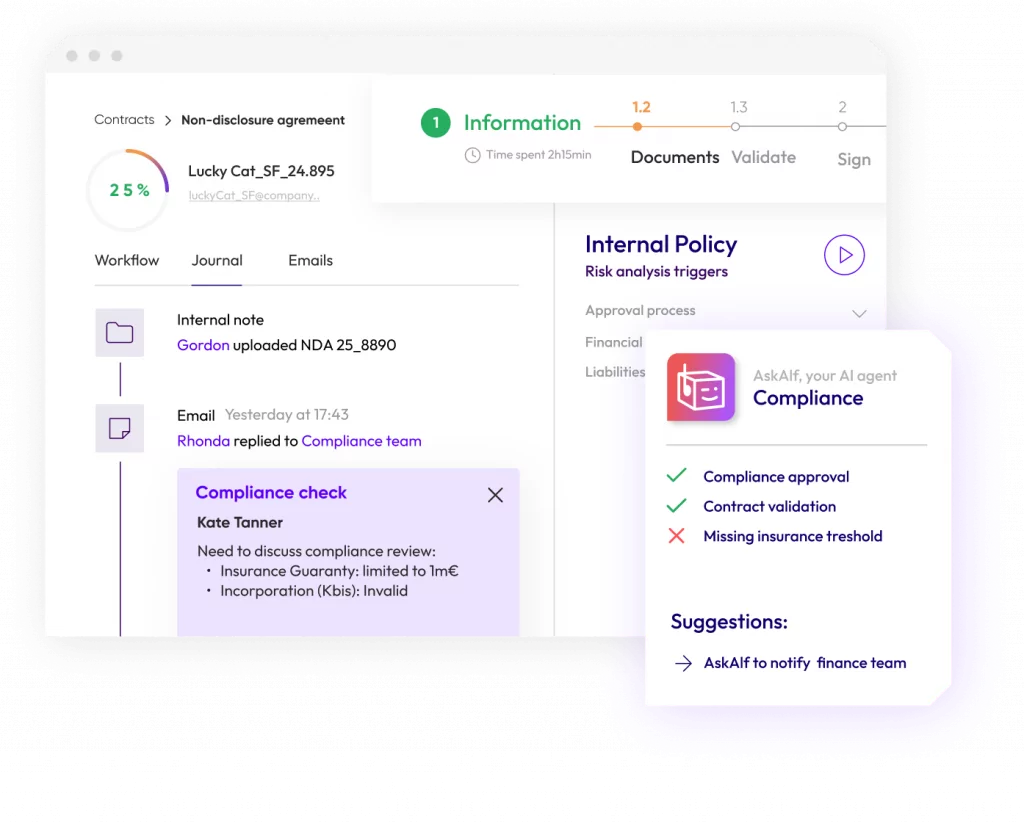
Alf is the operating infrastructure for global legal departments: it connects people, processes, knowledge and AI agents in one governed system. In Alf, each matter is handled in a dossier that brings together its documents, its deadlines and a chronological history of what happened. Teams can start a dossier from Outlook and link emails and attachments to it, so that a memo from a firm is filed with the work it belongs to rather than left in a personal inbox. Capabilities include configurable approval workflows, access permissions at user, group or dossier level, and a shared calendar with deadline alerts, which lets a group restrict sensitive advice to named people and route approval steps to the right owner.
The principle is the one this article describes: a piece of advice is useful to the group when its entity, its jurisdiction, its owner and the decision taken on it are recorded with it. Alf is designed to hold that context for people and for AI agents alike. An agent working on a matter summary operates from the advice it is permitted to see, within the permissions the group has set. Validations and decisions are logged, which makes it possible to respond when a regulator, a client or leadership asks how a matter was handled. The broader aim is to scale legal operations without scaling complexity. For teams that want to see how matters are structured across entities, the page on case management gives an overview. External expertise will remain part of how international legal departments work, and its value grows when the organization, not one inbox, is the one that keeps it.
How would one engagement look in a shared record? Bring a recent matter and walk through it with the Alf team.
Book a demoFrequently asked questions
What is the difference between outside counsel and in-house counsel?
In-house counsel are lawyers employed by the organization they advise. They know the business from the inside, including its risk appetite, its history and its internal stakeholders. Outside counsel work for an independent law firm and are engaged for a specific matter or period. They bring independence, local qualification or specialist depth that the in-house team does not have on a permanent basis.
The two roles are complementary rather than interchangeable. In-house counsel define the question, supply the facts and take the decision. Outside counsel provide the analysis or the representation that the question requires. The in-house team is responsible for making sure the advice reaches the right people and that the decision taken on it is recorded.
Is outside counsel the same as external counsel or general counsel?
Outside counsel and external counsel refer to the same role. Outside counsel is the more common term in American English; external counsel is more common in British English. Both describe lawyers who are not employees of the client and who are engaged through an independent law firm.
General Counsel is a different role entirely. The General Counsel is the most senior in-house lawyer and leads the legal department. One of the General Counsel’s responsibilities is deciding how and when the organization uses outside counsel, and on what terms.
Can advice given to one subsidiary be reused by another?
Sometimes, and only after checking. Advice depends on the law of a specific jurisdiction, on the facts provided and on the date it was given. An analysis of an EU regulation may be largely reusable across member states. An analysis of national employment or tax law usually is not, because the rules differ country by country.
Before reusing advice, confirm with the firm that it can be shared within the group and whether sharing has any effect on confidentiality or privilege in the relevant jurisdiction. Record who received it and for what purpose. If the facts differ materially from those the advice assumed, ask for an update rather than stretching the original to cover a situation it was not written for.
Who should be allowed to instruct outside counsel?
That is for each group to decide, and the decision should be written down. A common approach lets local counsel instruct firms for routine local matters within a defined budget. Engagements above a threshold, or on sensitive topics such as litigation, investigations or cross-border transactions, require approval from group legal before the firm is instructed.
Whatever the rule, every engagement should have one named in-house owner. That person briefs the firm, receives the advice and makes sure it is recorded with its context. Without a named owner, advice arrives and nobody is responsible for what happens next: whether it is shared, acted on or preserved for the next person who needs it.
How do we preserve knowledge when a lawyer leaves, on our side or at the firm?
Preserve the knowledge in the record of the matter rather than in a person’s memory or mailbox. That record should hold the brief, the advice, the conditions under which it applies and the decision taken. A successor can then pick up the matter with its full context, without having to reconstruct what happened from scattered emails or ask colleagues who may no longer be available.
On the firm’s side, ask for advice in written form and for a named second contact on important matters. On your side, review open engagements when someone changes role. The handover is far simpler when the history is already in one place and access permissions mean the right people can reach it immediately.