
Legal Operations Manager: Role, Scope and Coordination | Alf
Legal Operations Manager: Role, Scope and Coordination | Alf
TL;DR
A legal operations manager is responsible for how a legal department runs: its processes, tools, budget, vendor relationships and reporting, so that lawyers can focus on legal judgment. In an international group, the role becomes one of coordination across entities and jurisdictions, setting common rules, connecting local and central teams and deciding how AI agents participate in the work. The role sits between specialist positions, which run specific processes, and the director of legal operations, who owns the strategy. A practical first step is to take one real workflow that crosses at least two entities and make it explicit from end to end.
In this article
- What does a legal operations manager do?
- Legal operations manager, director, specialist, analyst: what is the difference?
- Why does the role change in an international group?
- What does a legal operations manager coordinate across countries?
- How does a legal operations manager govern AI agents?
- Where should a new legal operations manager start?
- How Alf supports the role
- FAQ
Consider a scene many legal departments will recognize. A request for a contract review arrives in the Polish subsidiary. Depending on who receives it, it goes to a local lawyer, to group legal or to outside counsel, and nobody can say which of the three routes is the rule. The problem is not the speed of the review. The problem is that three routes exist and none is written down. That is the problem a legal operations manager exists to solve.
What does a legal operations manager do?
A legal operations manager is responsible for how the legal department runs, as distinct from the legal advice it gives. The role covers processes, technology, budgets, relationships with outside counsel and other vendors, knowledge and reporting. The purpose is straightforward: lawyers should spend their time on legal judgment, and the department should be able to show the business what it does and what it costs. The legal operations manager typically reports to the General Counsel and works closely with finance, IT and procurement.
Professional bodies have mapped the field in detail. The CLOC Core 12 lists twelve functional areas, among them financial management, firm and vendor management, knowledge management, technology and project management. The ACC Legal Operations Maturity Model lets a department assess where it stands across each function. Few teams cover every area from the start. A legal operations manager typically begins with two or three of them and extends the scope as the department matures.
Legal operations manager, director, specialist, analyst: what is the difference?
The four titles describe levels of scope. An analyst works on data, a specialist runs a process or a tool, a manager owns the way the team operates, and a director sets the strategy. Titles vary from one organization to another, so the table below shows typical usage and should be read as a guide. In a smaller department, one person often covers all four.
| Role | Main focus | Typical scope |
|---|---|---|
| Legal operations analyst | Data and reporting | Collects and analyzes data on matters, spend and workload; maintains dashboards |
| Legal operations specialist | One or two processes or tools | Runs invoice review, contract intake or a system rollout; handles day-to-day administration |
| Legal operations manager | The operating model of the team | Owns processes, tools, vendor relationships and budget follow-up; coordinates across teams |
| Director of legal operations | Strategy and governance | Sets priorities with the General Counsel, owns the roadmap and leads the function across the group |
The difference between a manager and a director of legal operations is mostly one of mandate. The manager makes the model work day to day. The director, often called Head of Legal Operations, decides what the model should be, argues for the budget and represents the function in front of other departments. In a group with several countries, the director role tends to appear once the number of entities makes coordination a full-time subject.
Why does the role change in an international group?
In a single-country team, legal operations is mostly a matter of efficiency. In an international group it becomes a matter of coordination, because the same request, policy or contract is handled by different people under different rules in each entity. The issue isn’t that local teams are disorganized. It’s that no one has made the common rules explicit. Global legal teams should not become more complex every time the business grows.
Growth adds entities, countries, tools and information faster than it adds lawyers. Each subsidiary develops its own habits, often for good local reasons. The General Counsel then loses the ability to answer basic questions: how many matters are open across the group, who approved an exception in a given country, which version of a policy is in force in which jurisdiction. The legal operations manager is the person whose job is to make those questions answerable again.
What does a legal operations manager coordinate across countries?
A legal operations manager coordinates four things across countries: common rules, the links between teams, shared knowledge and reporting. Each one balances a group standard against local ownership. The aim is consistency in how work moves, with room for what local law and local practice require.
Common rules for intake and approval
A legal request should enter the department the same way in every entity and follow a known route. That route depends on the entity, the type of matter and the level of risk, and it should name the person responsible at each step. The same applies to approvals: who signs off on what, up to which threshold and with which exceptions. Writing these rules down is the first act of coordination, since most of them exist only in people’s heads.
Coordination between local and central teams
Local teams know their jurisdiction and their business. Group legal holds the policies and the overall picture. The legal operations manager defines how the two meet: which matters are escalated, to whom and within what timeframe. Cross-border work, such as a policy rollout across several countries, benefits from the methods of legal project management, which brings structure to dependencies, responsibilities and validation steps.
Shared knowledge
Advice, decisions and templates produced in one country are useful in others only if they can be found with their conditions of use. This includes advice from outside counsel, which tends to stay in the inbox of the person who requested it. It also includes signed agreements, which belong in a contract repository with a clear owner and defined access rules. The legal operations manager decides where this knowledge lives, who keeps it current and who can access it in each entity.
Reporting the group can read
Consolidated figures require common definitions. If one country counts every email as a matter and another counts only formal files, the group total means nothing. The legal operations manager’s first task is to agree on what a matter is, when it opens and when it closes. Useful indicators, to adapt to each department, include matter volume per entity, time to resolution and outside counsel spend against budget. The definitions matter more than the metrics themselves.
Do three routes exist for the same request in your group? Map one real workflow with the Alf team, entity by entity.
Talk to an expertHow does a legal operations manager govern AI agents?
Governing AI agents means deciding in writing what each agent may do, on which data, up to which threshold and at which point a person takes over. Lawyers already use general tools such as ChatGPT or Copilot on their own initiative. The legal operations manager’s task is to move from that individual use to work that follows the department’s rules. An agent that drafts a reply without knowing the validation path for a given entity creates the same risk as a new colleague who was never briefed on the rules.
In practice, this means giving agents the same structure people work within. Access follows the permissions of the matter. Human review is required at defined steps. A record is kept of what was validated and by whom. In the EU, the AI Act (Regulation (EU) 2024/1689) applies in stages: transparency obligations under Article 50 have applied since August 2, 2026, and obligations for high-risk systems follow on later dates. Which obligations concern a given use is a legal question for each department to assess. Whatever the answer, recorded validations and decisions make it possible to respond when a regulator, a client or leadership asks how AI was used on a matter.
The more autonomous AI becomes, the more organizational context matters.
An AI agent operating without explicit rules about who can do what, on which data, in which entity and up to which threshold is not governed. It is simply in use. The legal operations manager’s role is to make those rules explicit before agents are deployed, not after an incident makes the gap visible.
Where should a new legal operations manager start?
Start with one real workflow that crosses at least two entities, and make it explicit from the first request to the final record. A small, concrete case teaches more about how the department actually works than a full audit, and it produces a result people can see and react to. Good candidates are workflows that recur often and cause visible friction, such as contract review requests or contract renewal decisions.
Describe how the workflow runs today in each entity, including the informal steps. Name an owner for each step and write down the rule for each decision. Then agree on the common version with the local teams, and note the local exceptions that have a legitimate reason to exist. Only at that point does it make sense to choose or configure a tool. Repeating the exercise on a second workflow goes faster, because the roles and the vocabulary are already shared across the group.
How Alf supports the role
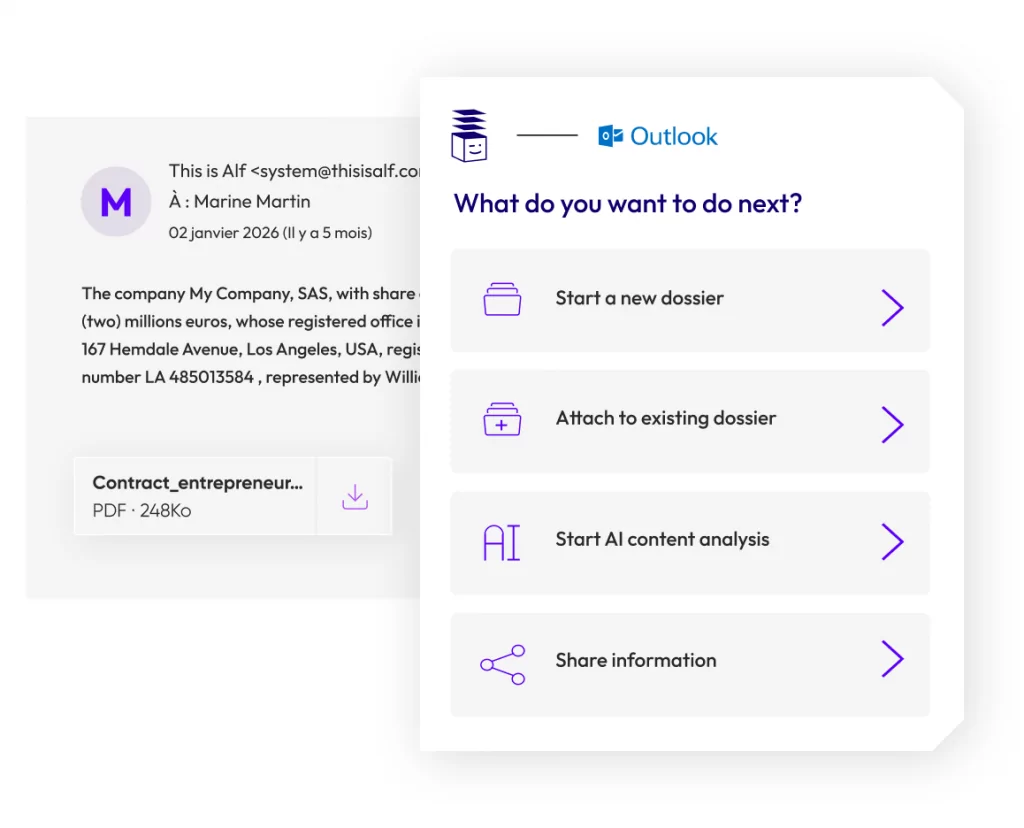
Alf is the operating infrastructure for global legal departments: it connects people, processes, knowledge and AI agents in one governed system. For a legal operations manager, that translates into a place where the rules described above can be configured and followed. Capabilities include configurable workflows and forms without code, approval circuits, a shared calendar with deadline alerts, access permissions at user, group or dossier level, activity reports and dashboards. Each matter is handled in a dossier that holds its documents and a chronological history of every action. Dossiers can be started and connected directly from Outlook, and documents can be generated from Alf templates based on Word models.
Alf is designed around what it calls Organizational Legal Context: a shared operating context that lets people and AI agents know who can do what, on what, in which entity, under which rule and with what level of autonomy. That is precisely the material a legal operations manager produces when making a workflow explicit. The value of the role shows less in the tools it selects than in the rules it gets written down and followed across countries. Alf helps international legal departments run their teams, processes and AI agents as one system, so that scale does not mean more complexity.
Building the operating model of your legal department? Bring one cross-entity workflow and work through it with the Alf team.
Book a demoFrequently asked questions
Is a legal operations manager a lawyer?
Not necessarily. Some legal operations managers are lawyers who moved toward organization and technology. Others come from finance, consulting, project management or IT. What the role requires is an understanding of how legal work is done and the ability to structure it across teams and entities.
A legal background helps with credibility inside the department. A background in operations helps with budgets, vendors and systems. Many departments combine the two profiles as the function grows, particularly when the scope extends to multiple jurisdictions.
Who does a legal operations manager report to?
In most departments, the legal operations manager reports to the General Counsel or to a deputy. In larger functions, the manager reports to a director of legal operations, who in turn reports to the General Counsel. The reporting line matters because the role changes how lawyers work and needs visible support from the top to be effective.
The role also has strong working relationships outside the department. Finance is a partner for budgets and spend tracking. IT, security and procurement are partners for any system the department adopts or renews.
When should a legal department hire its first legal operations manager?
There is no fixed threshold. The usual signals are organizational: the General Counsel spends significant time on budgets, vendors and tools rather than on legal matters; requests arrive through several channels with no consistent routing; and reporting takes days to assemble because data sits in different places. The number of entities and countries often weighs more than the number of lawyers in the department.
Some departments start by giving the responsibility part time to a lawyer or a paralegal. That can work for a while. A dedicated role becomes justified when coordination across entities turns into a continuous task rather than an occasional one.
What is the difference between a legal operations manager and a legal project manager?
A legal operations manager is responsible for how the department works over time: its processes, tools, vendor relationships and data. A legal project manager is responsible for delivering a specific piece of work, with a defined scope, a plan and an end date. The first builds the system; the second runs a project within it.
In practice the two overlap, and in many departments the same person does both. Project management is one of the functional areas commonly attributed to legal operations. The distinction becomes useful when large cross-border projects need someone dedicated full time to dependencies, timelines and stakeholder coordination.
Does the legal operations manager role vary depending on the jurisdictions the group operates in?
Yes, significantly. Local law shapes what rules can be standardized and what must remain local. Data protection requirements, approval thresholds, contract formalities and the scope of attorney-client privilege all vary by jurisdiction. A legal operations manager working across multiple countries cannot simply export the group’s home-country model and expect it to apply everywhere.
The practical approach is to distinguish between what must be common across the group, such as intake routing and escalation rules, and what must remain local, such as signature requirements or mandatory review steps under local law. Making those distinctions explicit is itself a coordination task, and it is one of the most valuable things the role produces.