
Contract Renewal: Keep Ownership Clear Across Entities | Alf
Contract Renewal: Keep Ownership Clear Across Entities | Alf
TL;DR
Contract renewal is the continuation of a contractual relationship beyond its initial term, by agreement or automatically. In a group, renewals rarely fail because nobody set a reminder. They fail because the reminder had no owner, no entity and no fallback. Every renewal deadline should be tied to three things: a named owner, the legal entity that signed and an escalation rule. The operative deadline is the notice deadline, which falls before the expiry date and is the one that must be tracked.
In this article
What is contract renewal?
Contract renewal is the continuation of a contractual relationship beyond its initial term. It happens in one of three ways: the parties agree to renew on the same or on new terms, the contract renews automatically unless one party gives notice within a set period, or the parties extend the term before it ends. The commercial result can look identical in all three cases. The legal effects are not always the same, and they depend on the law that governs the contract.
French law offers a clear illustration. The Civil Code distinguishes the extension of a contract before its term (Article 1213), its renewal, which as a default rule creates a new contract with the same content and an indefinite duration (Article 1214), and tacit renewal, where the parties simply continue to perform after the term (Article 1215). Other legal systems draw these lines differently, and local law may restrict or condition automatic renewal for certain contract types. A group cannot treat renewal as a single event defined once for all its subsidiaries. The governing law of each contract belongs in its record.
Why do contract renewals go wrong across subsidiaries?
Contract renewals go wrong across subsidiaries because the deadline is known to a system and owned by nobody. Consider a software contract signed by the German subsidiary that renews automatically for two years unless notice is given before a set date. The reminder goes to a procurement manager who left in March, and the group learns about the renewal from the invoice. Nothing in that scenario was hard to prevent. Every element of the failure was structural, not accidental.
Three features of a group make the problem worse. First, the date that matters is the notice deadline, and many trackers record only the expiry date. Second, the same supplier often holds contracts with several entities, on different terms and with different end dates, and no one sees them together. Third, the decision to renew is a business decision, while the deadline is kept by legal or procurement. When those functions do not share a view, the contract renews by default. The issue isn’t the alert. It’s the absence of an owner behind it.
What should every renewal deadline be tied to?
Every renewal deadline should be tied to an owner, an entity and an escalation rule. A date without these three is information. With them, it becomes a task that someone is responsible for and that the organization can follow. The table below lists what to record for each contract.
| Element | What to record | Why it matters |
|---|---|---|
| Owner | A named person in the business and a contact in legal | Someone must decide whether to renew, renegotiate or exit |
| Entity | The legal entity that signed, and any other entities that use the contract | Notice must come from the right party, and other users must be consulted |
| Notice deadline | The last date to give notice, and the form that notice must take | This is the operative deadline, ahead of the expiry date |
| Escalation rule | Who is alerted if the owner does not act, and when | People move and leave; the deadline stays |
| Decision record | What was decided, by whom and on what basis | The next renewal starts from this record |
These elements belong with the contract itself. In a group, the natural place is the contract repository, where the entity, the owner and the key dates are already part of each record. Assign ownership to a role as well as to a person, so that a departure triggers a handover rather than a gap. Review owners whenever the organization changes, since reorganizations are when renewals are most exposed.
Contract renewal process: six steps
A sound contract renewal process runs from recording the notice deadline at signature to recording the decision at the end. These six steps apply to any contract type and any jurisdiction, with local adjustments. The sequence matters more than the tool that supports it.
Record the notice deadline at signature
The best moment to capture renewal terms is when the contract is signed and the people who negotiated it are still available. Record the initial term, the renewal mechanism, the notice period and the form of notice. Calculate the notice deadline as a date, since “90 days before expiry” is easy to misread months later. If the contract requires notice by registered letter or to a specific address, record that too. This single step eliminates the most common source of missed deadlines.
Work back from the notice deadline
Start the review early enough to leave room for a real decision. The time needed depends on the contract: its value, the number of entities that use it, the approvals required and the difficulty of finding an alternative. No single lead time fits every agreement. Estimate the steps, add them up and set the start date by counting back from the notice deadline. For contracts that involve several entities, the planning methods of legal project management help put these steps in sequence and assign a responsible party to each one.
Make the owner decide: renew, renegotiate or exit
A renewal is a decision with three possible outcomes. Ask the business owner to choose one, with input on how the supplier has performed and whether the need still exists. Legal advises on the terms and on the notice mechanics. A renewal that happens because nobody chose is the outcome to avoid, even when the result would have been the same. Passive renewal is not a decision; it is the absence of one, and it leaves no record to build on.
Check what has changed since signature
Laws, group policies and the business itself change during the life of a contract. Renewal is the natural point to bring the terms up to date. Data protection clauses are a frequent example, given the requirements that Article 28 of the GDPR (Regulation (EU) 2016/679) places on contracts with processors. For financial entities in the EU, DORA (Regulation (EU) 2022/2554), applicable since January 17, 2025, sets requirements for contracts with providers of ICT services. Which rules apply to a given contract is a question for the legal team in each jurisdiction.
Look across subsidiaries before negotiating
Before one entity renews, check whether other entities hold contracts with the same supplier. Differences in price, term or liability often come to light at this stage. A group view strengthens the negotiation and may justify aligning end dates or moving to a single agreement. This is the kind of coordination a legal operations manager can organize across countries, and it requires a shared view of contracts by supplier, not just by entity.
Record the decision and update the record
Close the loop. Note what was decided, who approved it and why, then update the contract record with the new term and the next notice deadline. If the contract was terminated, keep the notice and proof that it was sent. The following renewal then begins with a history, and whoever handles it will not need to reconstruct the reasoning from memory or from scattered emails.
How many renewal deadlines in your group have a named owner? Map one real renewal with the Alf team, from the notice deadline to the recorded decision.
Talk to an expertWhy is an automatic reminder not enough?
An automatic reminder tells someone that a date is coming. It does not say who must decide, on behalf of which entity, or what happens if that person does nothing. Most teams that miss a renewal had a reminder somewhere. The problem was not the absence of an alert. It was the absence of a process behind it.
Four conditions that turn a reminder into a process
A reminder becomes part of a process when four conditions are met. It reaches a person who has the authority to decide. It arrives early enough for the steps that precede notice. It is repeated or escalated if nothing happens. And it leads to a recorded decision. Without these four conditions, alerts accumulate in inboxes and people learn to ignore them, which is a worse outcome than having no alert at all.
Ownership is what connects a date to an action. Assigning a role rather than only a person ensures that a departure does not leave a deadline without a responsible party. An escalation rule ensures that inaction triggers a response before the window closes. These are organizational decisions, not technical ones, and they must be made before the reminder fires.
A collection of reminders is not a renewal process. The difference is visible when someone leaves, when the organization changes or when a contract covers several entities at once. In each of those situations, a reminder without an owner and an escalation rule produces the same outcome: a renewal by default, with no record of why.
How Alf keeps renewals owned
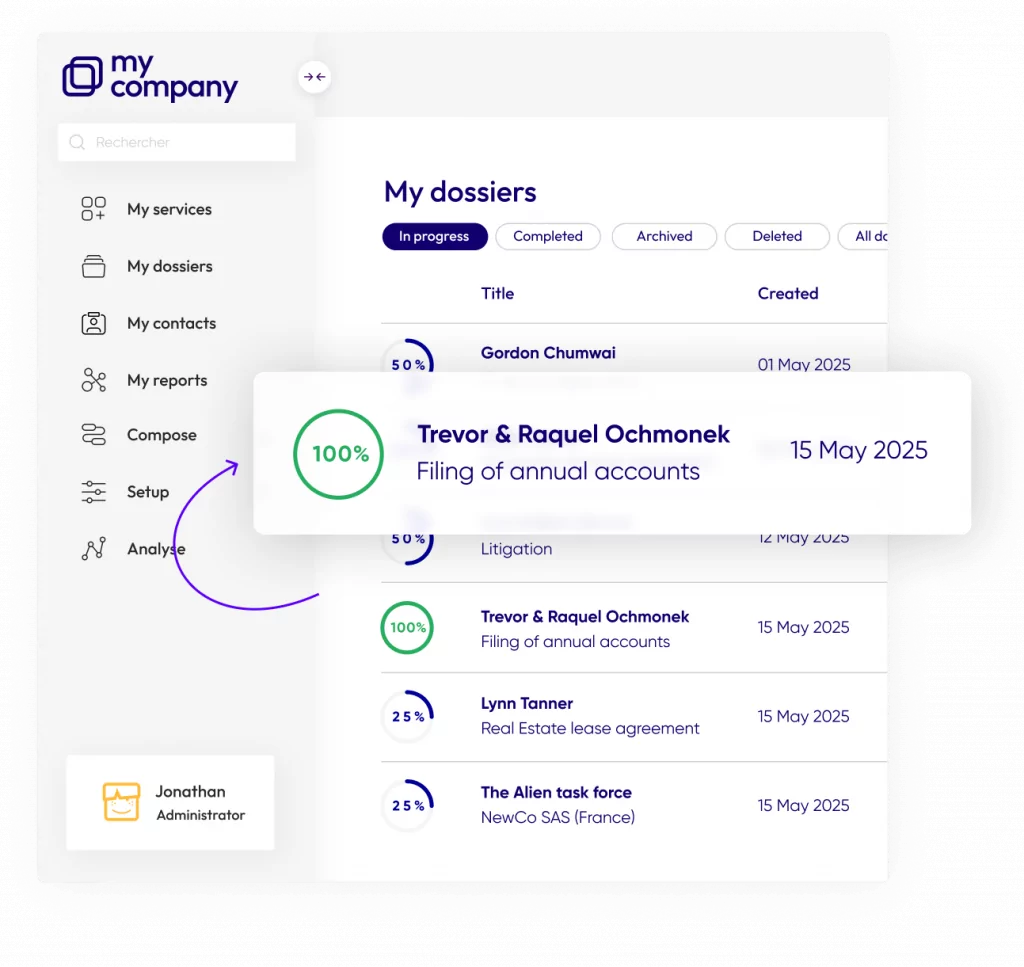
Alf is the operating infrastructure for global legal departments: it connects people, processes, knowledge and AI agents in one governed system. In Alf, a contract is handled in a dossier that holds its documents, its deadlines and a chronological history of what was done on it. Features include a shared calendar with deadline alerts, configurable approval workflows, access permissions at user, group or dossier level, activity reports and dashboards, and document generation from Word templates. Documents can be sent for signature through DocuSign, so that the renewed version joins the same record as the original.
The logic follows the structure set out above. A deadline is useful when it is attached to an owner, an entity and a rule. Alf is designed to keep that context together, for the people who decide and for AI agents that may prepare the review. Ownership is assigned to a role as well as to a person, so that a departure triggers a handover rather than a gap. Validations and decisions are logged, which means the next renewal begins with a history rather than a blank record. Legal departments that use Alf include Air France, SNCF, ENGIE Home Services and CCI Paris Ile-de-France. The aim is to scale legal operations without scaling complexity. A group that ties each renewal to an owner, an entity and an escalation rule turns a calendar of dates into a set of decisions, and that work can begin with the contracts that renew in the coming months.
Want to see how a renewal would be tracked for one of your entities? Bring one contract and walk through it with the Alf team.
Book a demoFrequently asked questions
What is the difference between a contract renewal and an extension?
In everyday use, both mean that the relationship continues past the original end date. Legally, they can differ. An extension usually prolongs the existing contract before its term ends, while a renewal may create a new contract, with consequences for duration and for the guarantees or warranties attached to the original agreement.
The distinction depends on the governing law and on the wording of the contract. French law, for example, treats extension, renewal and tacit renewal in three separate articles of the Civil Code. Other legal systems draw these lines differently. When the difference could have practical consequences, check the clause and the applicable law before choosing the mechanism.
How early should we start a contract renewal review?
Early enough to complete every step before the notice deadline, not before the expiry date. The right lead time depends on the contract. A low-value subscription needs little preparation. A group-wide agreement involving several entities, multiple approvals and a possible renegotiation needs considerably more.
A practical method is to list the steps required, estimate each one and count back from the notice deadline. Performance review, consultation of other entities, negotiation and internal approval all take time. Record the planned start date in the contract record so that it does not depend on memory or on the availability of a specific person.
Who should own contract renewals: legal, procurement or the business?
The decision belongs to the business owner of the contract, because the core question is whether the need still exists and whether the supplier meets it. Legal advises on the terms and on the notice mechanics. Procurement leads the commercial discussion where it is involved. Each function has a defined role; what matters is that the roles are clear before the process starts.
Many groups assign legal operations the task of keeping the calendar and triggering the process at the right time. The business owner then decides, and the decision is recorded. Assigning ownership to a role rather than only to a named person ensures that a departure does not leave a deadline without a responsible party.
How should we handle automatic renewal clauses across subsidiaries?
Start by identifying which contracts renew automatically, for how long and with what notice period. Record the notice deadline as a calculated date rather than as a formula, and attach an owner and an escalation rule to it. Automatic renewal clauses are only a problem when they are invisible or when the deadline is known to a system but owned by nobody.
In new contracts, consider whether automatic renewal serves the group and negotiate the renewal term and notice period accordingly. Local law may also limit or condition such clauses for certain contract types. That point should be checked with counsel in the relevant jurisdiction, since the rules vary across EU member states and beyond.
What if several subsidiaries use the same contract?
Record the signing entity as the party that must give notice, and list the other entities as users of the contract. Before the renewal decision, consult all of them, since a termination or a change in terms by one entity can affect the others. The owner of the decision should be someone who can speak for the group, not only for the entity that signed.
If several entities hold separate contracts with the same supplier, look at them together before any one entity negotiates. Different end dates make a joint negotiation harder. Aligning them, or consolidating into a single agreement, is a decision the group can take once it has a full picture of its exposure to that supplier across all entities.
Ready to map your renewal process entity by entity? Start with one contract type and build from there with the Alf team.
Talk to an expert