
Matter Management: How Legal Departments Run Work at Scale
TL;DR
Matter management gives each piece of legal work an owner, a defined scope, a status, a record, and a next step. A matter is broader than a case: it covers advice, contract review, investigations, regulatory work, and policy projects. The lifecycle runs from intake to closeout, and closeout means confirming open tasks, final decisions, and retained documents. For a group operating across multiple entities and jurisdictions, the challenge is not defining what a matter is — it is making sure every matter connects to the right people, rules, and context, regardless of where the request originates.
In this article
- What is matter management in a legal department?
- What does a matter record contain?
- How does the matter lifecycle work from intake to closeout?
- How does consistent matter data support portfolio-wide oversight?
- What should legal operations look for in matter management software?
- How Alf supports matter management across entities
- Frequently asked questions
What is matter management in a legal department?
Matter management is how an in-house legal department structures and oversees its legal work. Each request is linked to the people, documents, deadlines, decisions, costs, and business context it needs. The goal is not to create records for their own sake — it is to make sure that every piece of work has a named owner, a clear scope, and a traceable history, from the moment a request arrives to the moment the work is closed and retained.
A matter is broader than a case. A case is a dispute between particular parties. A matter can also cover preventive advice, contract review, a regulatory issue, an internal investigation, or a policy project. A task is one action within a matter, such as reviewing a clause. A project describes how the work is planned. The matter is the legal record that holds it all together.
Consider a request that arrives from a subsidiary in Germany. The business unit is working from one version of an employment policy. Outside counsel has another. The responsible lawyer is away. The legal question may be straightforward. The surrounding work is not: there is no reliable way to tell which information is current, who owns the request, or what happens next. That gap is precisely what matter management is designed to close.
For a group operating across multiple entities and jurisdictions, the issue is not whether to manage matters — it is whether the system connecting intake, ownership, documents, decisions, and spend is consistent enough to give leadership a real view of the portfolio. A collection of spreadsheets, shared folders, and email threads is not that system.
What does a matter record contain?
A useful matter record has a shared core that works across the group, plus fields that reflect the type of work. Common fields let you compare matters across entities. Work-specific details capture what matters for a dispute, a transaction, an investigation, or an advisory request.
Core fields and context
A matter record should show what the work concerns, who is responsible, where it applies, and what happens next. Core fields typically include a matter ID, title, opening date, status, and matter type. They also identify the requesting business unit, entity, country, and jurisdiction, along with the practice area, risk classification, urgency, and strategic importance.
Responsibility fields name the assigned in-house counsel, the legal operations owner, and any outside counsel involved. The record should also identify the relevant parties — opposing parties, regulators, suppliers, customers, employees, or internal stakeholders — and describe the risk level clearly. A high-risk classification might require senior approval, outside counsel review, or more frequent status updates. Defining those thresholds in advance, rather than case by case, is what makes the classification useful at the portfolio level.
Documents, decisions, and spend
Beyond the core fields, a matter record holds the documents, email exchanges, decisions, tasks, deadlines, and milestones that make up the work itself. On the financial side, it tracks the budget, invoices, expenses, accrual estimates, and approved changes. A matter budget estimates the cost of the defined work. An accrual estimates what the department expects to owe or spend, covering work already done and costs not yet invoiced. These figures answer different questions and should be kept separate.
Intake, workflows, document management, and reporting each support the matter record in a distinct way. Intake captures the request. Workflows govern the steps. Reporting uses the records to show workload, risk, status, and cost. The value of each depends on how consistently the underlying data is structured across the group.
Is ownership of each matter clearly recorded in your group? Map one real intake workflow with the Alf team, entity by entity, from the first request to the assigned owner.
Talk to an expertHow does the matter lifecycle work from intake to closeout?
The lifecycle starts when a request reaches the department and ends when the work is closed and retained under its rules. The main stages are intake, triage, assignment, active execution, monitoring, and closeout. Each stage has a defined output that feeds the next.
From request to assignment
Intake needs enough information to show what the request is about before it reaches a lawyer. A configurable intake form can require the business objective, the affected entity, the jurisdiction, the desired outcome, the key dates, the known parties, the supporting documents, and the cost of delay. This gives the department a consistent starting record instead of requiring lawyers to recover basic facts from later messages.
Triage weighs urgency, legal risk, complexity, business impact, practice area, conflicts, required expertise, and available capacity. A routine contract review and a potential regulatory breach may arrive through the same channel. They should not be routed the same way. Routing logic can reflect the entity, jurisdiction, practice area, urgency, risk level, or business unit — but only if those fields are captured at intake.
Assignment should match the work to expertise and capacity. That means choosing a lawyer by practice area, jurisdiction, and current workload, or deciding whether outside counsel is needed. It also means naming who can approve the scope, the budget, or a change in risk level. Leaving those approvals implicit is one of the most common sources of delay and confusion in a multi-entity group.
Active work and closeout
While work is active, the matter owner keeps the matter’s content, status, deadlines, and scope current. A matter plan can split the work into phases, assign tasks, set review points, and record the assumptions behind the budget. Ownership may transfer when a lawyer changes role or work moves to outside counsel — and that transfer should be recorded in the matter, not managed by memory.
Closeout requires more than changing the status to complete. Before closing, the owner should confirm that open tasks are resolved, that final invoices are processed, that key decisions and documents are retained, and that the business contact has received the agreed outcome. A later event may justify reopening a closed matter, which is why the record needs to be complete at the point of closure, not reconstructed afterward.
The issue is not the work. It is the context around it.
Most legal departments have competent lawyers and adequate tools. What they often lack is a shared operating context: a consistent record of who can do what, on which matter, in which entity, under which rule, and with what level of autonomy. When that context lives in people’s heads rather than in a governed system, every handover, every departure, and every new entity adds complexity instead of capacity.
Matter management is the discipline that makes that context explicit. The system that holds it is what determines whether the discipline scales.
How does consistent matter data support portfolio-wide oversight?
Consistent matter data lets a Group General Counsel review the portfolio by status, owner, entity, jurisdiction, practice area, deadline, and spend. Legal Operations can then coordinate work systematically, not through individual follow-up. That shift — from chasing updates to reading a shared record — is what makes oversight possible at group level.
Shared matter categories can work across entities without blocking local detail. A group might use common categories for litigation, contracts, regulatory, employment, privacy, and commercial advice, then add the classifications each jurisdiction requires. The key is that the shared layer is defined at group level, not assembled from whatever each subsidiary happens to track.
Historical data supports planning when categories and ownership stay stable over time. Comparing previous matter types, recurring outside counsel work, typical phases, and demand patterns from across the business becomes possible only when the underlying records are structured consistently. The goal is not more dashboards. Each view should have an owner and inform a defined decision. A dashboard that nobody acts on is not oversight — it is noise.
For legal operations, the practical implication is that matter data standards need to be set before the system is populated, not retrofitted after. Defining common fields, risk classifications, ownership rules, and closure criteria at the outset is what makes the portfolio readable at scale. The legal operations manager typically owns that architecture, even when individual matter owners are responsible for keeping their records current.
What should legal operations look for in matter management software?
The right system fits how the department works across entities and jurisdictions. The starting point is not a feature list — it is a clear definition of the workflows, permissions, reporting needs, and ownership rules the system needs to support. A system that cannot reflect the group’s actual approval thresholds, entity structure, or access rules will be worked around, not adopted.
A dedicated matter system should handle intake, assignment, approvals, updates, closure, documents, deadlines, and reporting. It should keep shared fields consistent across the group while leaving room for local rules. A global policy might set an approval threshold. A local workflow might require a specific entity representative or a jurisdiction-specific review step. Both need to be expressible in the same system without one overriding the other.
Financial capabilities matter for groups that use outside counsel. Spend should connect to the matter, law firm, phase, business unit, and cost center. Invoice review and approval workflows should follow the same logic as matter approvals — not operate as a separate process that nobody reconciles with the matter record. For more on managing external spend at group level, see how legal departments structure outside counsel relationships.
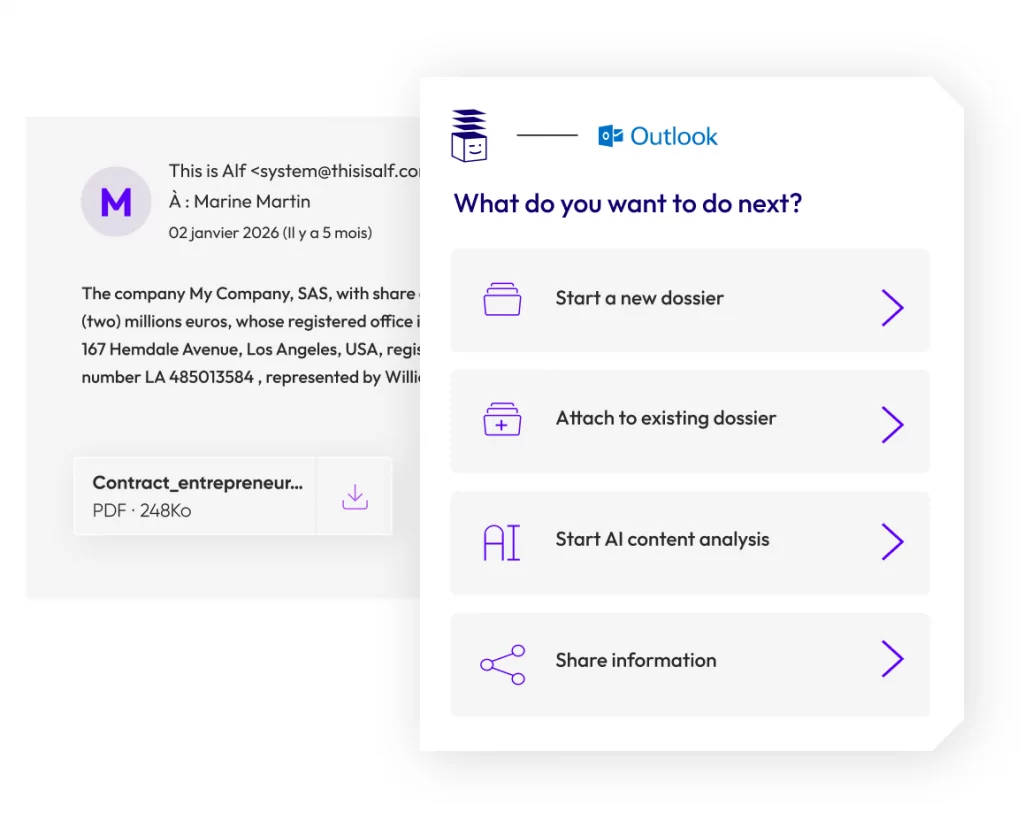
Integration with how lawyers already work is a practical requirement. If a matter cannot be started from an email, if documents cannot be attached without leaving the system, or if the intake form requires information that the business unit does not have, adoption will be partial. Partial adoption produces incomplete records, and incomplete records undermine the portfolio oversight that justified the investment. Legal project management disciplines — defining phases, assigning tasks, setting review points — can be built into the matter system or run alongside it, but they need to connect to the same record.
How Alf supports matter management across entities
Alf is the operating infrastructure for global legal departments: it connects people, processes, knowledge, and AI agents in one governed system. For matter management specifically, Alf is designed to make the context around each piece of work explicit and shared — the entity, the applicable rule, the responsible role, the approval threshold, the access rights, and the decision record — so that oversight does not depend on individual memory or manual follow-up.
Alf’s features for matter management include centralized dossiers and documents, configurable workflows and forms without code, approval circuits, a shared calendar with deadline alerts, a chronological history for each dossier, dossier creation directly from Outlook, document generation from Word templates, electronic signature, access rights by user, group, or dossier, a multilingual interface, and activity reports and dashboards. The AI agent works from the context of each dossier. Validations and decisions stay recorded in the process, which makes it possible to respond when leadership, a regulator, or a client asks how a matter was handled.
The operating model that Alf supports is one where a new entity joins the existing structure rather than adding a new layer of complexity. Group policies become workflows that respect local requirements. A request from a German subsidiary, a French holding company, or a newly acquired business in another jurisdiction enters the same governed system, with the same intake logic, the same ownership rules, and the same closure criteria. That is what it means to scale legal operations without scaling complexity. Legal departments including Air France, SNCF, ENGIE Home Services, and CCI Paris Ile-de-France use Alf to run their teams, processes, and AI agents as one system.
How many open matters in your group have a named owner and a current status? Bring one real matter and walk through it with the Alf team, from intake to closure.
Book a demoFrequently asked questions
What is the difference between a matter, a case, and a task in legal operations?
A matter is the legal record that holds everything connected to a piece of legal work: the people, documents, decisions, deadlines, costs, and business context. It is broader than a case, which refers specifically to a dispute between identified parties. A matter can cover preventive advice, contract review, a regulatory issue, an internal investigation, or a policy project — any work the legal department owns.
A task is one action within a matter, such as reviewing a clause, sending a notice, or obtaining a signature. A project describes how the work is planned and sequenced. The matter is the record that holds the task list, the project plan, and the history of decisions together. Keeping these three concepts distinct helps legal operations design intake forms, workflows, and reporting that reflect how work actually moves through the department.
Who owns matter management in an in-house legal department?
Ownership operates at two levels. Legal Operations owns the process: the data standards, intake logic, workflow design, reporting structure, and system governance. That includes defining common matter categories, risk classifications, approval thresholds, and closure criteria across the group. Without that layer, each team or entity tends to track work differently, which makes portfolio-level oversight impossible.
Individual matter owners — typically the assigned in-house counsel — are responsible for keeping each matter’s content, status, deadlines, and scope current. When a lawyer changes role or work moves to outside counsel, ownership transfers, and that transfer should be recorded in the matter. The distinction between process ownership and matter ownership is important: conflating them is one of the reasons matter management programs stall after initial rollout.
How should a legal department start a matter management program?
Start with one recurring workflow that crosses a clear organizational boundary — commercial contract requests from several subsidiaries, for example, or employment matters that involve both local HR and group legal. Define the intake fields, triage rules, ownership, approval points, and closure criteria for that workflow before expanding. Testing the model on real matters from several entities and jurisdictions will surface the gaps that a theoretical design misses.
Resist the temptation to design the complete taxonomy before running anything. A shared set of matter categories that the group actually uses is more valuable than a comprehensive classification scheme that each entity interprets differently. Build the shared layer first, then add local detail. The goal is a system that legal operations can govern and that lawyers will use consistently — not a system that is technically complete but practically ignored.
Does matter management vary depending on the jurisdiction or governing law?
The core discipline — giving each piece of work an owner, a scope, a record, and a next step — applies regardless of jurisdiction. What varies is the content of the record and the rules that govern specific steps. Approval thresholds, document retention requirements, privilege rules, and the involvement of local counsel all depend on the applicable law and the regulatory environment of the entity concerned.
For a group operating across multiple jurisdictions, this means the matter system needs to accommodate local variation without abandoning group-level consistency. A global policy might set a standard approval threshold. A local workflow might require an additional review step that the group policy does not mandate. Both need to be expressible in the same system. Designing for that flexibility at the outset — rather than retrofitting it after the system is live — is one of the most consequential decisions in a matter management implementation.
How does matter management connect to outside counsel and spend tracking?
Outside counsel engagement should be a defined step within the matter, not a parallel process that runs separately. The decision to involve external counsel — and the scope, budget, and approval for that engagement — belongs in the matter record. When invoices arrive, they should connect to the matter, the law firm, the phase, the business unit, and the cost center, not sit in a billing system that nobody reconciles with the legal record.
For groups that use outside counsel across multiple entities and jurisdictions, the practical challenge is making that connection consistent. Different subsidiaries may have different billing guidelines, different approval rules, and different relationships with the same firm. Matter management provides the structure that makes those differences visible and governable at group level, rather than leaving each entity to manage its external spend independently.
Ready to see how matter management works across your entities? Walk through a real workflow with the Alf team.
Book a demo