
AI Governance Framework Legal Checklist
TL;DR
An AI governance framework legal checklist turns principles into decisions, owners, controls, and evidence. For a group operating across multiple entities and jurisdictions, the same AI tool can carry very different legal consequences depending on which entity uses it, on which data, and for which decision. The checklist must follow each AI system from discovery to retirement, with a named owner and an approval decision at every stage. Employment, credit, and state-regulated uses require separate legal review. The first step is building a shared inventory that makes every AI use visible to the legal department.
In this article
- What an AI governance framework legal checklist should cover
- Start with inventory and context
- Assess risk, data, and suppliers before approval
- How to turn the checklist into an operating process
- What EU legal obligations the checklist must account for
- What U.S. legal obligations the checklist must account for
- How accountability, training, and evidence work in practice
- How Alf supports AI governance across entities
- Frequently asked questions
Consider a group headquartered in Europe with subsidiaries in Germany, Spain, and the United States. A local team uses a generative AI tool to review customer complaints. Another uses a vendor to rank job applicants. Legal learns about both only when someone asks who approved the data access. The issue is not the number of tools. It is the absence of a shared model that defines what each system may do, in which entity, on which data, and up to which threshold.
That is what an AI governance framework is for. It turns principles into decisions, owners, controls, and evidence. The checklist below covers every AI system you build, buy, or use, across entities and jurisdictions. The NIST AI Risk Management Framework provides a sound structural base, but it does not replace legal analysis and does not create binding obligations on its own.
What should an AI governance framework legal checklist cover?
A practical framework serves four functions, drawn from the NIST AI RMF structure: govern, map, measure, and manage. Govern means setting policies, roles, accountability structures, and risk tolerance at group level. Map means recording the system’s purpose, context, users, affected people, and possible harms before deployment. Measure means testing performance, security, bias, and reliability against defined thresholds. Manage means choosing a response to each identified risk, whether mitigation, transfer, acceptance, avoidance, correction, or suspension.
One distinction must remain clear throughout the checklist. An internal governance framework is your company’s own operating model. A voluntary framework such as the NIST AI RMF gives you structure and a common vocabulary. A law creates binding duties within a defined scope, covering notice, human review, risk assessment, record retention, and explanations of adverse decisions. Every item in the checklist should be labeled as one of these three: an internal control, a voluntary practice, or a response to a specific legal obligation. Mixing the three categories without labeling them is one of the most common reasons a governance framework fails under scrutiny.
Start with inventory and context
The checklist follows each AI system from discovery to retirement. Context must be captured before risk, because the same tool can carry very different consequences depending on which entity uses it, on which data, and for which decision. A drafting tool used by a legal team in one jurisdiction may become a high-risk system the moment it is repurposed to rank employees or influence credit decisions in another.
For each entry in the inventory, record the business problem the system addresses and the specific task it performs. Record whether the system informs, recommends, ranks, drafts, or materially influences a decision. Assign a business owner, a technical owner, a supplier contact, a legal reviewer, a privacy lead, and a security lead. Record the legal entity, the jurisdiction, the data categories involved, the deployment environment, the risk level, the approval decision, the human review threshold, access rights, the retention period, and the incident escalation route. Note the applicable group policy and any local exception. This structure keeps the framework usable whether the system is built in-house, bought from a vendor, or embedded in an existing workflow.
Undeclared tools must also appear in the inventory. Software access logs, expense records, security monitoring, legal intake records, and interviews with local teams reveal embedded AI features, local scripts, and vendor capabilities that were never submitted for central approval. Record them first, then decide whether to approve, restrict, replace, or stop each one.
How should risk, data, and suppliers be assessed before approval?
Set risk thresholds before reviewing individual systems. A drafting tool may need approved data access, output review, and basic logging. A system that ranks candidates, shapes a customer decision, or influences access to services needs stronger evidence, a named decision owner, meaningful human review, and a documented way to challenge the outcome. The approval record should name the control owner and the test that supports each control.
For data, check where it comes from and whether the entity is permitted to use it for this purpose. Confirm it is accurate enough for the intended decision and identify which entity controls it. For suppliers, review the intended use, known limitations, security measures, sub-processors, change notice procedures, audit rights, and incident handling obligations. Security controls should address unauthorized access, excessive permissions, data leakage, malicious instructions hidden in inputs, manipulated reference data, unsafe connections to other tools, and weak separation between entities.
Before deployment, test the system against its intended purpose and identified risks. Record the test scope, method, result, tolerance, reviewer, and decision. Human review must be meaningful: the reviewer needs authority, knowledge, time, and access to information sufficient to challenge or change the output. Define when correction is mandatory and when the system must be suspended. Record how overrides are handled and by whom.
Is the decision role of each AI system in your group clearly documented? Map one real AI use with the Alf team, entity by entity, from intake to approval record.
Talk to an expertHow can a company turn the checklist into an operating process?
A checklist becomes a process when every new AI use goes through the same admission path and receives a decision that someone can explain later. The admission path starts when a team proposes a new AI use. Legal operations checks whether an approved pattern already covers the case or whether a new assessment is needed. The use is then mapped by affected people, data sensitivity, decision importance, autonomy, scale, and reversibility of errors. Relevant risks are measured through testing, supplier evidence, and security and privacy review. The result is managed by approving, approving with conditions, requesting changes, postponing, or refusing the use.
Reassess after any change in purpose, data source, supplier, model, jurisdiction, affected population, decision role, or access level. A system approved to summarize internal documents may need a new review once it starts ranking employees or generating external-facing content. Assign a review owner and a review frequency based on risk level. Suspend or retire a use when the group cannot control a material risk or cannot produce the required evidence on request.
In a global group, group policy sets the baseline and local owners add jurisdiction-specific controls and exceptions. The central record must keep both layers. A local deviation that disappears into an email thread or a subsidiary spreadsheet is not a governed exception: it is an undocumented risk. The legal operations function is responsible for maintaining the integrity of that central record across entities.
The operating model question behind AI governance
The future of legal is an operating model problem before it is an AI problem. An AI governance framework only works if the organization behind it is structured to receive it: clear ownership, shared policies, visible workflows, and a record that survives personnel changes. A checklist without that structure produces paperwork, not governance.
The most common failure point is not the risk assessment. It is the gap between the group policy and what actually happens in each subsidiary. Closing that gap requires a system where group rules become local workflows, where exceptions are recorded rather than tolerated, and where a new entity can join the model without rebuilding it from scratch.
What EU legal obligations should the checklist account for?
For groups with entities in the European Union, the AI Act (Regulation (EU) 2024/1689) is the primary binding reference. Its application is phased. Prohibited practices and obligations to maintain control over AI systems have applied since February 2, 2025. Obligations for general-purpose AI models apply from August 2, 2025. Transparency obligations under Article 50 apply from August 2, 2026. Obligations for high-risk systems listed in Annex III are deferred to December 2, 2027, and those in Annex I to August 2, 2028, under Regulation (EU) 2026/1744.
The checklist must identify which AI Act category applies to each system: prohibited, high-risk, limited-risk, or minimal-risk. For high-risk systems, the required evidence includes conformity assessments, technical documentation, human oversight measures, and logging. The practical implication for legal departments is that recorded validations and decisions make it possible to respond when a regulator, a client, or leadership asks how AI was used on a matter. The AI Act does not require legal departments to prove their AI use in a specific form, but the absence of records makes any response to a regulatory inquiry significantly harder.
The GDPR (Regulation (EU) 2016/679) remains relevant wherever AI systems process personal data. Article 28 requires a written contract between a controller and a processor. Any AI supplier that processes personal data on behalf of a group entity is a processor, and the checklist must confirm that a compliant data processing agreement is in place before deployment. For groups in the financial sector, DORA (Regulation (EU) 2022/2554), applicable since January 17, 2025, adds specific contractual requirements for ICT service providers, including AI vendors.
What U.S. legal obligations should the checklist account for?
U.S. AI obligations sit across federal laws, sector rules, agency positions, and state requirements. There is no single federal AI law of general application. Start with the use case, the people affected, the legal entity, and the state where the activity occurs. The FTC can act against unfair or deceptive practices, including misleading claims about what an AI system does, how it protects privacy, or how it uses data. Keep a record of claims made to users and data-use commitments made to customers.
Employment and credit uses require specific legal review. Employment uses must be checked for discrimination, disability accommodation obligations, and prohibited inquiries under applicable federal and state law. Credit decisions must provide accurate and specific adverse-action reasons, even when a complex model contributes to the outcome. These are not AI-specific rules: they are existing legal obligations that apply with additional complexity when an automated system is involved.
State rules require a jurisdiction register. Colorado SB26-189 applies to consequential automated decision-making in employment, housing, lending, insurance, health care, education, and public benefits, for decisions made on or after January 1, 2027. Developers must provide deployers with technical documentation. Deployers must give notices, support data correction and human review rights, and keep compliance records. California’s regulations on automated decision-making technology introduce additional requirements on a separate timeline. The checklist must track which state rules apply to each use and what records they require, because the answer differs by jurisdiction and by the role the group entity plays in the AI supply chain.
How should accountability, training, and evidence work in practice?
Assign accountability by decision, not by department name. Each AI use needs one clear owner for each part of the work. The business owner accepts the operational purpose. Legal assesses the applicable rules. Privacy reviews personal information. Security assesses technical threats. The technical owner maintains the controls. Senior leadership sets the risk tolerance and resolves escalations. When accountability is assigned to a team rather than a named individual, it belongs to no one.
Acceptable-use rules should state which tools are approved, which data users may enter, which uses need prior approval, and which outputs must be verified before acting on them. Training should vary by role. Users need practical instructions for approved tools and data. Reviewers need challenge and correction procedures. Owners need monitoring and incident duties. Suppliers need contractual and escalation requirements. Everyone needs a clear way to report problems: harmful output, unauthorized use, inaccurate data, security events, or failed human review.
Each incident record should show the system, the entity, the jurisdiction, and the people affected. It should also show the severity, the decision owner, the correction taken, and the follow-up action. This record is not only an internal control: it is the evidence base that makes it possible to respond to a regulator, a counterparty, or leadership when they ask what happened and who was responsible. A useful first step is to identify the AI use in your group where the decision role is least clear, and run it through the admission path. That single case will show where the process needs tightening before it is extended across the organization.
How Alf supports AI governance across entities
Alf is the operating infrastructure for global legal departments: it connects people, processes, knowledge and AI agents in one governed system. For AI governance, that means the framework does not live in a shared drive or a policy document that no one updates. It lives in the system where legal work actually happens.
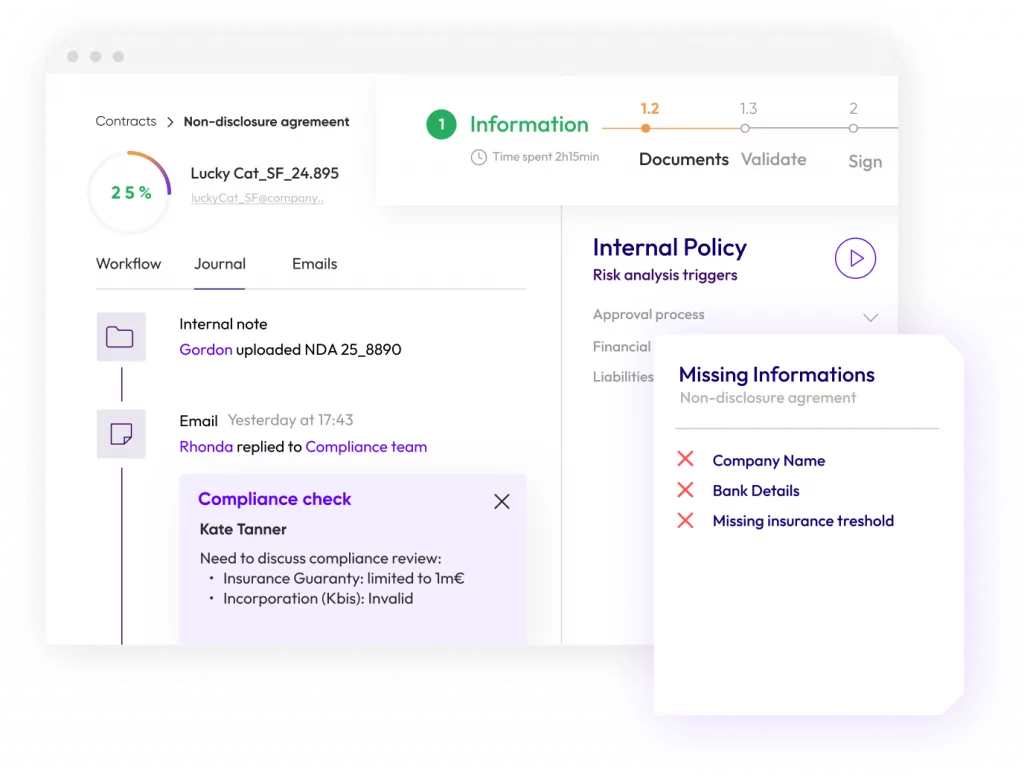
Alf is designed to make the governance layer operational. Each AI use can be tracked as a dossier, with a named owner, a linked approval workflow, access rights by entity, and a chronological history of every decision and override. Configurable workflows and forms route new AI intake requests to the right reviewer based on entity, data category, and risk level, without requiring code changes each time the group adds a jurisdiction or a new use case. Alerts and a shared calendar surface reassessment deadlines before they are missed. The agent AI in Alf operates within the Organizational Legal Context, a shared operational context that defines who can do what, on which data, in which entity, according to which rule, and up to which threshold of autonomy. Validations and decisions are logged, so when a regulator or leadership asks how AI was used on a matter, the answer is in the record.
Legal departments that have structured their AI governance in Alf include Air France, SNCF, ENGIE Home Services, and CCI Paris Ile-de-France. The goal is not a longer checklist. It is a governed operating model where AI agents know what they can do, humans know when to step in, and the group can scale without losing control.
Is your group’s AI governance framework operational or still a document? Bring one AI use and walk through its approval path with the Alf team, entity by entity.
Book a demoFrequently asked questions
What is the difference between an AI governance framework and a legal checklist?
An AI governance framework is the operating model that defines how a company makes decisions about AI: who owns each use, what risks are acceptable, how approvals work, and what evidence must be kept. It covers policies, roles, workflows, and accountability structures across the organization. A legal checklist is a tool within that framework: it translates the framework’s requirements into a structured set of items to verify for each AI system, from inventory and risk assessment to supplier review and incident handling.
The two are complementary but not interchangeable. A checklist without a governance framework produces isolated reviews that do not add up to a coherent operating model. A governance framework without a checklist remains abstract and difficult to apply consistently across entities and jurisdictions. For a global group, both are necessary, and both must be maintained as the AI landscape and the regulatory environment evolve.
When does an AI use require meaningful human review?
Human review is required when an AI system materially influences a decision that affects a person’s employment, access to credit, housing, insurance, health care, education, or public benefits, and in any other context where the group’s risk assessment or applicable law requires it. The threshold should be set before deployment, not after an incident. A human name added to a process after the decision has already been made does not constitute meaningful oversight.
For review to be meaningful, the reviewer must have the authority to change the outcome, the knowledge to evaluate the output, the time to do so, and access to the information the system used. Each override must be recorded. When these conditions cannot be met, the system should not be deployed for that use. Defining the review threshold and the reviewer’s role is one of the most important items in the AI governance framework legal checklist.
Does the EU AI Act require legal departments to document how they use AI?
The AI Act (Regulation (EU) 2024/1689) does not impose a general documentation obligation on legal departments as such. Its obligations apply based on the role an entity plays in the AI supply chain, whether as a provider, deployer, or user, and on the risk category of the system involved. High-risk systems listed in the Act’s annexes carry the most demanding requirements, including technical documentation, conformity assessments, and logging of operations. The applicable obligations depend on the specific system and the entity’s role.
In practice, recorded validations and decisions make it possible to respond when a regulator, a client, or leadership asks how AI was used on a matter. Legal departments that have no record of their AI approvals, risk assessments, or human review decisions are in a weaker position regardless of whether a specific provision formally requires that record. The governance framework should treat documentation as an operational necessity, not only as a regulatory response.
How long should AI governance records be kept?
Retention periods depend on the use, the jurisdiction, applicable law, and contractual obligations. There is no single answer that applies across all entities and all AI systems. The inventory entry, risk assessment, approval decision, test results, incident records, override logs, and retirement decision should all be retained long enough to explain the use if it is later questioned by a regulator, a counterparty, or in litigation. Colorado SB26-189 requires deployers to keep compliance records for at least three years for covered automated decision-making uses.
For a global group, retention schedules should be set at group level and adjusted for local requirements. The central record must reflect both the group baseline and any jurisdiction-specific obligations. A retention decision made only at subsidiary level, without visibility at group level, creates the same gap as any other undocumented local exception.
How does Alf support an AI governance framework across multiple entities?
Alf is designed to make the governance layer operational rather than documentary. Each AI use can be tracked as a dossier with a named owner, a linked approval workflow, access rights by entity, and a chronological history of every decision and override. Configurable workflows route new AI intake requests to the right reviewer based on entity, data category, and risk level. Alerts and a shared calendar surface reassessment deadlines before they are missed.
The AI agent in Alf operates within a shared operational context that defines who can do what, on which data, in which entity, and up to which threshold of autonomy. Validations and decisions are logged, so the evidence base exists when it is needed. The system is built to connect people, processes, knowledge, and AI agents across entities and jurisdictions in one governed system, so that a new entity can join the operating model without rebuilding the governance framework from scratch.