
AI in Legal Operations: Governance Before Automation
TL;DR
AI in legal operations is most useful when it supports a defined workflow with a clear owner, explicit data rules, and a named reviewer. The harder problem is not the tool: it is the operating context around it. Intake, approvals, and decisions still move through email and chat in most legal departments, which means AI arrives in a system whose rules have never been made explicit. Before running a pilot, a legal department needs to answer six governance questions for each workflow: purpose, data, access, authority, escalation, and record. Start with one recurring workflow, measure it against its baseline, and build from there.
In this article
AI in legal operations still focuses mostly on documents. The harder part is how work moves. A request arrives from a subsidiary. The intake form records the business question. It does not record the entity, the governing policy, the risk level, or who has to approve it. An AI tool produces a tidy summary. The actual decision ends up scattered across email, chat threads, and a matter folder nobody has opened in a week. A summary can be correct. The process around it still needs clear ownership, review, and a record of the decision.
The issue is not the tool. It is the operating context in which the tool is asked to work. AI should increase capacity, not increase chaos. That means settling governance before automation, not after.
What AI in Legal Operations Covers
AI in legal operations applies artificial intelligence to the work that organizes legal demand, information, decisions, and follow-up across a department. It operates at two levels. At the task level, AI summarizes a matter, extracts a clause, or drafts a first-pass response. At the operating-model level, AI routes a request to the right team under the right policy, flags a missing approval, or surfaces a related precedent from a prior matter. Most current use sits close to document work: review, research, summarization, drafting, and correspondence. These are sensible places to start. On their own, they do not add up to an operating model for a legal department.
The distinction matters because document-level AI and operating-model AI require different governance. A tool that drafts a clause needs a reviewer who understands the contract. A tool that routes an intake request needs rules about which entity is responsible, which policy applies, and who can approve an exception. Most legal departments have invested in the first category. The second is where complexity compounds across entities and jurisdictions, and where the absence of explicit rules becomes a liability as AI becomes more autonomous.
Which Workflows Can AI Support, and Where Does a Person Need to Check?
AI works best when three conditions are met: the input is clear, the decision repeats, and a named person reviews the result at a defined point. The more a task involves legal judgment, business risk, privileged information, or an external commitment, the more human review it requires. The table below maps common workflow types to useful AI support and the review point that must remain with a qualified person.
| Workflow type | Useful AI support | Human review point |
|---|---|---|
| Legal intake | Classify the request, identify the entity and jurisdiction, detect missing information | Confirm priority, owner, risk level, and routing |
| Matter knowledge | Retrieve related documents, build a chronology, organize key facts | Check the source record and decide what matters legally |
| Contract work | Extract clauses, compare language, prepare a first-pass review | Confirm interpretation, fallback position, and approval |
| Investigation or e-discovery | Transcribe, translate, cluster, and summarize large datasets | Validate relevance, privilege treatment, and legal conclusions |
| External communication | Draft a response from approved matter information | Approve accuracy, tone, authority, and release |
For each workflow, the reviewer needs to verify source citations, dates, defined terms, entity names, jurisdiction, applicable policy, privilege status, and any conclusion the source does not support. The review record should show who approved the result and when. This is not a formality: it is the evidence that a human exercised judgment, which becomes relevant whenever a regulator, a client, or leadership asks how AI was used on a matter. Under the EU AI Act (Regulation (EU) 2024/1689, eur-lex.europa.eu), obligations are being phased in by use-case category, and recorded validations and decisions make it possible to respond when that question is asked.
Which Risks and Controls Matter Most?
The main risks are data handling, incorrect output, unclear authority, and lost context. Controls answer four practical questions: what information can a tool access, how long is it kept, who can use it, and when must a person review the result. These questions need answers before a tool is deployed, not after the first incident.
Confidentiality starts before any information enters a tool. Check the vendor’s data terms, access controls, and retention settings. A permission that is appropriate for one entity may be far too broad for another. In a group operating across multiple jurisdictions, the same tool may face different legal constraints depending on the entity using it and the data involved. Local counsel or the data protection officer should be consulted where personal data or privileged material is in scope.
Six questions every AI governance rule should answer
- Purpose: Which legal use case is permitted, and what business problem does it solve?
- Data: Which matter information, personal data, privileged material, or company records may be used?
- Access: Which role, member, entity, or outside counsel can see the information?
- Authority: Who approves the output before it changes a position or reaches the business?
- Escalation: What event moves the work to senior legal review?
- Record: Where are the input, output, decision, approval, and any exception stored?
These six questions apply to every workflow, not just the ones that feel risky. A routine intake classification that routes work to the wrong entity, or a matter summary that omits a privilege flag, can have consequences that are not visible until much later. Writing down the answers before a pilot starts is also what makes it possible to scale: a new entity can join the model without rebuilding the core control structure, because the rules are explicit rather than held in someone’s memory.
Do your AI workflows have a named owner and a recorded decision for each matter? Map one real workflow with the Alf team, entity by entity.
Talk to an expertHow to Introduce AI and Measure the Result
Start with one recurring workflow that has a clear owner and a decision someone can review. Legal intake, knowledge retrieval, and matter summarization are practical choices because the inputs are relatively structured and the review point is easy to define. Define the inputs, routing rules, and approval points first. Only then consider adding autonomy to any step.
A pilot should name five things before it starts: the user group, the workflow owner, the reviewer, the escalation route, and the process for reporting errors. It should also define what happens in three edge cases: the tool cannot classify a request; it finds conflicting policies; it produces an answer with no reliable source. Writing down the response to each case before launch is what separates a governed pilot from an experiment that generates risk without generating learning.
Measure the workflow against its baseline, not speed alone. Three measures are worth tracking from the start. Routing time: how long a request takes to reach the right owner. Rework: how often a request comes back because information or approval was missing. Review effort: how much professional time is needed to validate the output. Speed is a consequence of getting the other three right, not a target in itself. A workflow that routes faster but generates more rework has not improved. A workflow that reduces review effort without increasing error has.
The more autonomous AI becomes, the more organizational context matters. That context includes which entity owns a matter, which policy applies, who has authority to approve, and where the record of the decision lives. A tool that operates without that context does not reduce complexity: it moves it somewhere less visible. Settling these questions at the workflow level, before scaling, is what makes it possible to add AI agents without adding chaos.
How Alf Supports Governed AI in Legal Departments
Alf is the operating infrastructure for global legal departments: it connects people, processes, knowledge, and AI agents in one governed system. The platform is designed to give AI the organizational context it needs to operate within defined boundaries, rather than alongside a fragmented set of tools and inboxes.
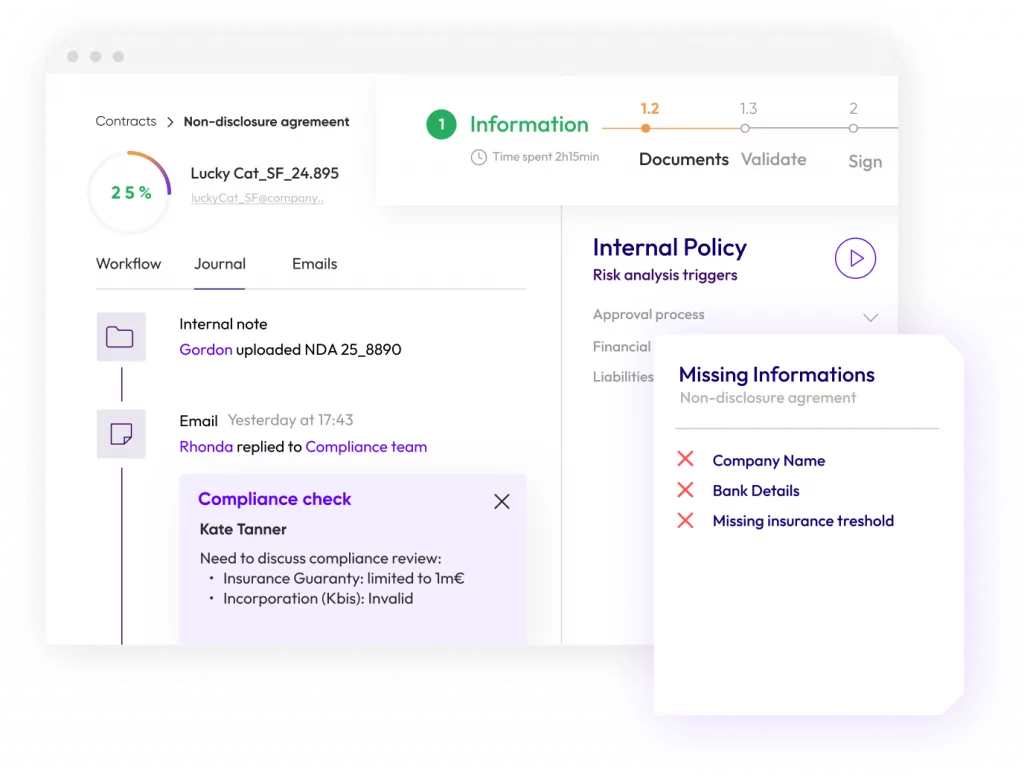
Features relevant to AI governance in legal operations include: centralized dossiers with chronological matter histories, configurable workflows and approval paths, a shared calendar with deadline alerts, document generation from Alf templates, electronic signature, and access rights set by user, group, or dossier. An AI agent connected to Alf works within the permissions and matter context already defined in the system. The agent knows which entity a matter belongs to, which documents are in scope, and when a human needs to take over. Validations and decisions are logged, which makes it possible to respond when a regulator, a client, or leadership asks how AI was used. The system stays yours. The model behind it can change.
Legal departments including Air France, SNCF, ENGIE Home Services, and CCI Paris Ile-de-France use Alf to run their teams, processes, and AI agents as one system. The goal is not to add a layer of tools. It is to make the operating model explicit enough that AI can work within it. Scale legal operations without scaling complexity.
Ready to see what a governed AI workflow looks like across your entities? Bring one matter type and walk through it with the Alf team.
Book a demoFrequently Asked Questions
Does AI in legal operations replace legal judgment?
No. Legal professionals remain responsible for assessing AI output, applying judgment, and approving decisions. The degree of review required depends on the task, the information involved, and the consequences of error. A routine matter summary may need only source checking. A regulatory conclusion or an external position requires qualified legal review before it reaches the business or a counterparty.
The practical question is not whether to review, but how to structure the review so it is consistent, recorded, and proportionate to the risk. A governance rule that defines the review point for each workflow type makes that structure explicit and repeatable across entities.
What is the difference between task-level AI and operating-model AI in a legal department?
Task-level AI assists with a specific piece of work: drafting a clause, summarizing a document, or extracting key dates from a contract. It makes an individual task faster or easier. Operating-model AI works at the level of how demand flows through the department: routing an intake request to the right entity, applying the correct policy, flagging a missing approval, or surfacing a related precedent from a prior matter.
Most legal departments have started with task-level AI because it is easier to deploy and the value is immediately visible. Operating-model AI requires that the rules of the organization be made explicit first: who owns which type of matter, which policy applies in which jurisdiction, and who can approve an exception. Without that context, AI at the operating-model level either fails silently or routes work incorrectly.
How does AI governance scale across a group with multiple entities and jurisdictions?
It scales when the group sets common principles and makes local differences explicit. The starting point is to write down which policies apply group-wide, which rules belong to each jurisdiction, and who can approve an exception. A new entity can then join the model without rebuilding the core control structure, because the rules are documented rather than held in the memory of a specific team member.
The practical challenge is that most groups have not made these rules explicit at all. They exist as informal practice, distributed across email threads and individual judgment. Introducing AI in that environment does not simplify the situation: it surfaces the gaps. Mapping the governance questions for one workflow, entity by entity, is a more productive starting point than deploying a tool group-wide and discovering the gaps afterward.
Which data rules apply when a legal department uses AI tools that process matter information?
The applicable rules depend on the jurisdiction of the entity processing the data, the nature of the information involved, and the contractual relationship with the tool vendor. Where personal data is processed, the EU General Data Protection Regulation (Regulation (EU) 2016/679, eur-lex.europa.eu) requires that the relationship between a data controller and a data processor be governed by a written agreement. For financial entities in the EU, the Digital Operational Resilience Act (Regulation (EU) 2022/2554, eur-lex.europa.eu), applicable since January 17, 2025, imposes specific contractual requirements for ICT service providers.
Beyond regulatory requirements, a legal department should check the vendor’s data terms, access controls, and retention settings before any matter information enters a tool. A permission that is appropriate for one entity may be too broad for another. Privileged material and personal data require separate treatment, and local counsel should be consulted where the applicable rules are not clear.
How does Alf connect AI agents to matter context in a legal department?
Alf is designed to give AI agents access to the organizational context that governs a matter: the entity it belongs to, the documents in scope, the applicable workflow, the approval path, and the access rights of each user. An AI agent working within Alf operates within those boundaries rather than against a generic dataset. When a human needs to take over, the handoff point is defined by the workflow, not by the agent’s own assessment.
The system works with multiple AI models, and the model behind it can change without changing the governance structure. Validations and decisions are logged within the matter history, which means the department can demonstrate how AI was used on a specific matter if asked by a regulator, a client, or leadership. Alf’s data is hosted within the European Union, encrypted at rest and in transit, and protected by two-factor authentication and role-based access rights.