
Group Legal Policies: Two Meanings, One Governance Problem
TL;DR
The phrase “group legal policies” covers two distinct problems: employer-sponsored legal benefit plans for employees, and internal governance rules that control how legal work is requested, approved and recorded across a corporate group. Confusing the two creates real operational risk. For a legal department operating across multiple entities and jurisdictions, the governance problem is the harder one: policies need named owners, documented approvers, and exceptions with expiry dates. The right next step is to inventory the rules already in force and identify which ones have no clear owner.
In this article
Two meanings, one phrase
An employee searching for help with a landlord dispute or a will drafting question may type “group legal policies” and land on a corporate governance article that tells them nothing useful. A Group General Counsel using the same phrase to describe the rules that govern legal work across subsidiaries, countries and business units needs a completely different answer. Both searches are legitimate. The confusion between them creates real operational problems: requests routed to the wrong team, exceptions approved by the wrong person, and decisions that nobody can trace later.
The first step is to identify which meaning applies. The second is to treat each one with the rigor it requires.
Group legal plans: what employees need to know
A group legal plan is an employer-sponsored benefit that gives eligible employees access to prepaid legal services or a network of attorneys for personal matters. It does not cover the employer’s own legal work, and it does not give an employee an unlimited right to any attorney. It is an access and payment arrangement, shaped entirely by how the employer has designed the plan.
What a plan typically covers
Coverage varies from plan to plan. Common categories include wills and estate planning, buying or selling a home, family law matters, traffic matters, debt collection and elder-care issues. A general category in the plan summary does not confirm coverage for a specific matter. Before contacting an attorney, an enrolled employee should check their eligibility, the matter category, whether the attorney is in-network, and how the plan handles out-of-network fees.
Typical exclusions include employment matters, disputes involving the employer, business or farm matters, and patent, trademark or copyright questions. Filing fees, court costs, fines and other third-party charges usually remain with the employee. Appeals and class actions can be excluded even when the subject appears personal.
How costs are structured
Employee cost can appear as a payroll deduction, an employer-paid benefit, or a combination of both. The monthly premium alone does not tell the full story. Deductibles, copays, uncovered expenses and network rules all affect what the employee ends up paying. Some plans cover network services without copays or deductibles; others do not. Employees should separate the recurring premium from filing fees, court costs and anything else the plan does not cover. For a multinational group, local payroll and tax rules apply to each subsidiary independently.
Running a group legal plan requires ongoing administration: eligibility files, enrollment communications, payroll deductions, employee questions and plan changes. That operational load belongs with the benefits function, not the corporate legal department.
Are internal legal policies scattered across entities in your group? Map one real governance workflow with the Alf team, entity by entity.
Talk to an expertInternal group legal policies: what the legal department needs to build
An internal group legal policy sets how legal work is requested, reviewed, approved, recorded and updated across a corporate group. It is not an employee benefit. It gives no one a personal attorney network. Its purpose is to make the rules governing legal work explicit, traceable and consistent across entities and jurisdictions, while allowing documented local variation where the business or the law requires it.
The issue isn’t that rules differ between entities. It’s that nobody can say why they differ. A subsidiary using a different approval threshold for the same type of matter is not a problem in itself. A quiet local habit with no documented rationale, no named owner and no review date is.
Start with an inventory
Before designing a governance structure, list the policies that already shape legal work across the group. The inventory should cover legal intake, contract approval, outside counsel engagement, litigation reporting, signing authority, entity governance, data handling and AI use. Look for duplicates and conflicting instructions. If two subsidiaries operate under different rules for the same type of matter, the difference needs a documented reason. An inventory that surfaces these gaps is more useful than a policy framework built on assumptions about what already exists.
The inventory also reveals which policies have no named owner, which exceptions have quietly become permanent, and which rules exist only in someone’s memory. Those are the highest-priority items to address before adding any new layer of governance. For a practical framework on the functional scope of legal operations, the CLOC Core 12 provides a useful reference across domains including information governance, knowledge management and technology.
Owners, approvals and exceptions
A usable internal policy record answers five questions: which entities, teams, matters and jurisdictions does the rule cover; who maintains the policy and answers questions about how it applies; who can authorize the rule and any material change to it; who can approve a departure and up to what level of risk; and where are the decision, the rationale, the evidence and the effective version kept. Without answers to all five, the policy exists in name only.
Separating ownership from approval
Ownership and approval authority are not the same role. The owner maintains the policy, monitors its application and fields questions. The approver authorizes the rule and any material change to it. Approval authority should follow the scope and risk of the policy. A local procedure may need sign-off from a regional legal lead. A group-wide rule may need the Group General Counsel, the executive committee or the board, depending on the group’s delegation framework. Conflating the two roles is one of the most common reasons policies drift without anyone noticing.
Exceptions need limits and evidence
Every exception to a group legal policy should name the policy, the entity, the jurisdiction, the matter, the business reason, the risk, the alternative control and the approver. It also needs a review date or a clear end condition. Without those fields, an exception becomes an informal override that later reviewers cannot follow and auditors cannot assess. The owner should be reminded before the review date arrives and should record whether the exception ends, renews or becomes a permanent change to the policy.
Exception authority should follow the same delegation logic as approval authority. A regional legal lead may approve a short operational deviation. A group-wide departure may require escalation to the Group General Counsel or above. The key discipline is that every approved exception stays visible in the same place as the policy it departs from, not in a separate email thread or a local folder that only one person knows about.
What a complete policy record contains
A policy record that can withstand an audit or a leadership review covers: the scope of the rule (entities, jurisdictions, matter types); the named owner; the named approver and the delegation level required; the exception authority and the conditions under which it applies; and the location of the current version, the prior versions and any approved exceptions with their review dates. If any of these fields is missing, the record is incomplete.
How to tell which problem you have
When a search or a request uses the phrase “group legal policies,” the surrounding language usually signals which meaning applies. Benefit language points to an employee access question. Legal operations language points to an internal governance problem. Both can exist in the same organization at the same time, and keeping them separate is part of the legal department’s operational discipline.
Signals that point to the employee benefit
References to payroll deductions, dependents, enrollment windows, legal insurance, attorney networks, wills, family law or covered matters usually indicate an employee searching for their group legal plan. That person needs eligibility information, coverage details, exclusions, attorney access and cost. The right destination is the benefits portal, the plan summary or the plan administrator, not the corporate legal department.
Signals that point to internal governance
References to subsidiaries, entities, jurisdictions, legal intake, approval thresholds, outside counsel engagement, delegation, exceptions, version control or AI agents point to an internal governance problem. That problem requires a structured approach: named owners, documented approvers, recorded exceptions with expiry dates, and a single place where the current version of each policy lives. A personal attorney benefit does not solve it.
Whichever meaning applies, the underlying risk is the same: decisions that nobody can trace later. Start with the exceptions already in force. Give each one a named owner and a review date. Then check which ones have quietly lapsed or become permanent without anyone authorizing that outcome.
How Alf supports group legal policy governance
Alf is the operating infrastructure for global legal departments: it connects people, processes, knowledge and AI agents in one governed system. For a legal department managing internal group legal policies across multiple entities and jurisdictions, the core challenge is making rules explicit, traceable and consistently applied without creating a separate administrative burden for every subsidiary.
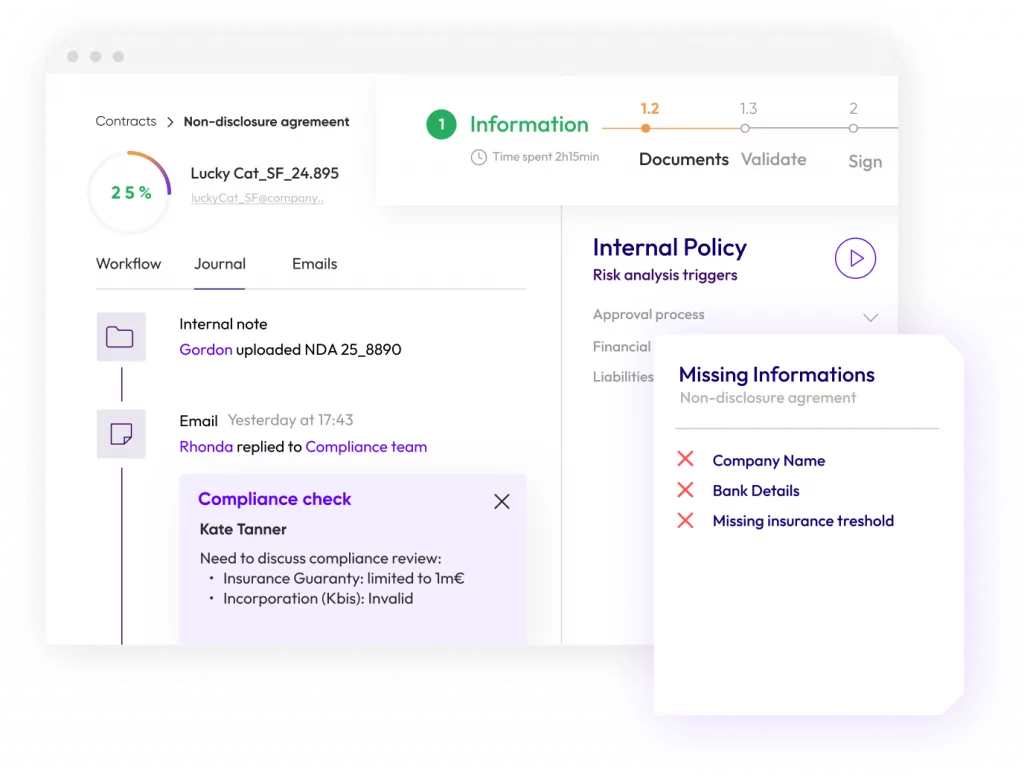
Alf is designed to hold that structure. Each policy, each exception and each approval can be attached to a dossier with a named owner, a role-based access configuration and a chronological history of every decision. Configurable workflows and approval circuits mean that a request from a subsidiary follows the right path for its entity, matter type and risk level, without requiring the group legal team to intervene manually at every step. When an AI agent operates within a dossier, it works within the same governed context: it knows what it can do, on which data, up to which threshold, and when a human needs to take over. Recorded validations and decisions make it possible to respond when a regulator, a client or leadership asks how a matter was handled or how AI was used.
Alf helps international legal departments run their teams, processes and AI agents as one system. For a group managing legal policies across entities, that means the rules governing legal work are no longer scattered across inboxes, local folders and individual memory. They live in one place, with owners, approvers and exceptions that are visible to the people who need to act on them. Scale legal operations without scaling complexity.
How many of your group’s internal legal policies have a named owner and a current review date? Bring one policy and walk through its governance structure with the Alf team.
Book a demoFrequently asked questions
What is the difference between a group legal plan and an internal group legal policy?
A group legal plan is an employer-sponsored benefit that gives employees access to attorneys for personal legal matters such as wills, home purchases or family law. It is an access and payment arrangement, not a governance framework. The employer designs the plan, sets eligibility rules and determines which matters are covered. Employees enroll during a defined window and use the plan for their own legal needs, not for the employer’s legal work.
An internal group legal policy governs how legal work is requested, approved, recorded and updated across a corporate group. It applies to the organization’s own legal operations: contract approval thresholds, outside counsel engagement rules, litigation reporting, signing authority and similar matters. It requires named owners, documented approvers and recorded exceptions. The two are entirely separate and should be administered by different functions.
Who should own an internal group legal policy?
Ownership and approval authority are distinct roles and should not be held by the same person for the same policy. The owner maintains the policy, monitors its application, answers questions about how it applies and triggers reviews when circumstances change. The approver authorizes the rule and any material change to it. For a group-wide policy, the approver is typically the Group General Counsel, the executive committee or the board, depending on the group’s delegation framework.
A policy without a named owner drifts. When a change in law, an audit finding or a new business requirement makes a review necessary, there is no one accountable for initiating it. Assigning ownership is not a formality: it is the mechanism that keeps a policy current and enforceable across the group.
Can one internal legal policy apply across several jurisdictions?
Yes. A single group policy can set a common framework that applies across multiple jurisdictions. The policy defines the baseline: scope, ownership, approval authority, exception process and record-keeping requirements. Local variations are then documented as part of the policy record, identifying which jurisdictions they cover, why they differ from the group standard and who approved the variation.
The risk is not that local variations exist. It is that they exist without documentation, so they cannot be reviewed, updated or explained to an auditor or a regulator. A policy that accommodates local law while keeping variations visible is more robust than one that pretends uniformity where it does not exist.
How should exceptions to internal legal policies be managed?
An exception should name the policy it departs from, the entity and jurisdiction involved, the matter type, the business reason, the risk, the alternative control in place and the person who approved it. It also needs a review date or a clear end condition. Without those fields, an exception becomes an informal override that later reviewers cannot assess and that may quietly become permanent without anyone authorizing that outcome.
Exception authority should follow the same delegation logic as policy approval. A short operational deviation at the subsidiary level may be within a regional legal lead’s authority. A departure from a group-wide rule may require escalation to the Group General Counsel or above. The discipline is to keep every approved exception visible in the same system as the policy it modifies, not in a separate email thread or a local folder.
How does Alf help manage internal group legal policies across entities?
Alf is designed to give a legal department operating across multiple entities and jurisdictions a single governed system for its policies, workflows and decisions. Each policy, exception and approval can be attached to a dossier with a named owner, role-based access and a chronological record of every decision. Configurable workflows and approval circuits route requests from subsidiaries through the correct path for their entity, matter type and risk level, without requiring manual intervention at every step.
When AI agents operate within the system, they work within the same governed context: they know what they can do, on which data, up to which threshold, and when a human needs to take over. Recorded validations and decisions make it possible to respond when leadership, a client or a regulator asks how a matter was handled. Legal departments using Alf include Air France, SNCF, ENGIE Home Services and CCI Paris Île-de-France.