
Legal Department Operations: Structure, Metrics & Control
TL;DR
Legal department operations is the function that turns fragmented legal work into a managed operating model with clear ownership, workflows, data and review points. It does not replace legal judgment: lawyers keep analysis, advice and sign-off. For a group operating across multiple entities and jurisdictions, the challenge is making that operating model consistent without making it rigid. Start with one operational pain point, map its workflow, then decide whether technology can support it.
In this article
- What legal department operations covers
- Which competencies belong to legal operations?
- How should a global legal team divide responsibilities?
- How to assess and improve legal department operations
- Which data and metrics show legal department value?
- How technology, processes and contracting fit together
- What current pressures reveal about the operating model
- Why information and knowledge governance matter
- How Alf supports legal department operations
- Frequently asked questions
Most legal departments know what they spent last year. Far fewer know which requests are open today, who owns them and which entity they belong to. When work depends on memory and scattered inboxes, nobody can check it. Legal department operations gives each request an owner, a clear path and a record.
Consider a request from a subsidiary in Germany that needs a local contract review. The applicable policy sits on SharePoint. The latest template is buried in an email thread. The approval threshold lives in someone’s memory. Meanwhile an AI agent can reach the documents but does not know which entity or jurisdiction governs the matter. Nothing here is unusual. It is what most legal departments look like once they grow past a certain size. Effective legal department operations turns this fragmented work into a managed operating model: clear ownership, workflows, permissions, data and review points, so the General Counsel can see what work exists, who owns it, how it moves and what the department can prove.
What legal department operations covers
Legal department operations covers the activities that shape how a corporate legal function delivers its services. It applies business principles, process design, data and technology to improve consistency, efficiency and value across the department. It does not take legal judgment away from lawyers, who remain responsible for analysis, advice, risk decisions and sign-off.
Legal practice answers questions of law. It advises on risk, rights and obligations. Legal operations organizes the conditions around that work: intake, matter assignment, budgets, external resources, information, reporting, technology adoption and service standards. The distinction matters because conflating the two leads either to lawyers spending their time on administrative coordination or to operational decisions being made without the right process controls.
Where the function sits
The function can sit inside the office of the General Counsel or operate as a dedicated team. Its work may be spread across lawyers, paralegals, project managers, finance specialists, technology professionals and administrators. In a global department, it often shares responsibilities with corporate IT, procurement, finance, information security or business operations. The question is not where the team sits on an org chart but whether each operational capability has a named owner and a working process.
Lawyers remain responsible for legal analysis, advice, risk decisions and sign-off. Legal operations makes the relevant context easier to find, routes work to the right person, records the decision and gives the General Counsel a clearer view of capacity, cost and risk. That division of labor only works when the handoffs between legal judgment and operational process are explicit.
The scope depends on the department
The right scope depends on structure, business model, entities, jurisdictions, workload, budget and available skills. A department supporting a regulated financial group needs stronger controls over outside counsel, records, regulatory work and information access than a department supporting a single domestic business. Maturity models help leaders compare the current state with a realistic target, but they are not a universal scorecard. Use a model to find a specific gap, not to label the whole department. If requests get lost between business units, start with service delivery and contract management. If outside counsel spend is hard to explain, start with financial management, matter data and vendor management.
Which competencies belong to legal operations?
The CLOC Core 12 framework splits legal operations into twelve competencies: Business Intelligence, Financial Management, Firm and Vendor Management, Information Governance, Knowledge Management, Organization Optimization and Health, Practice Operations, Project and Program Management, Service Delivery Models, Strategic Planning, Technology, and Training and Development. These describe capabilities, not job titles. In a small team, one person may cover several areas. In a large global function, each area may have its own specialist team. What matters is whether each capability has an owner, a process, usable data and a clear link to business priorities.
The ACC Legal Operations Maturity Model uses fourteen functional areas and adds Contract Management, eDiscovery, Innovation Management, Intellectual Property Management, Internal Resources Management, Metrics and Analytics, Process and Project Management, Change Management and Communications, and Strategic Planning and Legal Operations Leadership. In day-to-day work, both frameworks converge on five practical areas: business intelligence, financial management, firm and vendor management, practice operations, and talent and strategy.
| Operating question | CLOC Core 12 | ACC model |
|---|---|---|
| Main purpose | Build operational excellence across twelve capability areas | Benchmark maturity across fourteen legal operations functions |
| People and talent | Organization Optimization and Health, Training and Development | Internal Resources Management, Change Management and Communications |
| Work delivery | Practice Operations, Service Delivery Models | Contract Management, eDiscovery, Process and Project Management |
| Data and control | Business Intelligence, Financial Management, Information Governance | Metrics and Analytics, Financial Management, Information Governance |
| Technology and change | Technology, Strategic Planning | Technology Management, Innovation Management, Strategic Planning and Legal Operations Leadership |
| Best use | Structure capabilities and develop skills | Assess maturity and set improvement priorities |
Five practical areas in daily operations
Business intelligence turns matter, spend, workload and service data into information for decisions. Financial management covers budgets, invoices, accruals, forecasts, outside counsel rates, alternative fee arrangements and the link between spend and outcomes. Firm and vendor management covers selection, onboarding, billing guidelines, performance reviews, rate discussions and the split of work between internal and external resources. A useful process matches the type and risk of work to the resource best placed to handle it.
Practice operations improves how routine legal work reaches lawyers and how lawyers return it to the business. Legal project management coordinates initiatives such as a contract intake redesign, an entity management program or a global policy rollout. Talent, strategy and training connect capabilities to the plan: recruiting, onboarding, work allocation, development, communications, change management and the skills needed to use new workflows and technology responsibly.
How should a global legal team divide responsibilities?
A legal operations team can be centralized, embedded in practice groups, organized by region or built as a hybrid. A centralized team typically owns the operating model, technology roadmap, metrics, budgets, vendor relationships and common workflows. Regional or practice-based leads handle local processes, adoption, language, jurisdiction-specific requirements and business relationships. The right division depends on the department’s structure and the services it delivers.
Lawyers remain responsible for legal analysis, advice, risk decisions and sign-off. Legal operations owns the process around them: collecting the request, checking required information, assigning the matter, tracking deadlines, recording the decision and reporting the outcome. A global department should make the handoffs explicit. For each recurring service, define the requesting entity, jurisdiction, applicable policy, matter owner, approval threshold, permitted data, escalation route, final decision-maker and location of the record.
| Responsibility | General Counsel and legal leaders | Legal operations | Lawyers and legal specialists |
|---|---|---|---|
| Strategy | Set direction, risk tolerance and business alignment | Translate priorities into plans, resources and measures | Advise on legal implications and execution |
| Budget | Approve funding and tradeoffs | Prepare forecasts, monitor spend and report variances | Estimate matter needs and manage approved work |
| People | Set structure and seniority needs | Coordinate capacity, roles, training and change | Allocate legal work and develop legal expertise |
| Vendors | Approve key relationships and commercial choices | Run selection, onboarding, guidelines and performance data | Assess legal quality and matter-specific performance |
| Technology | Sponsor priorities and accept risk decisions | Define requirements, roadmap, adoption and governance | Validate workflow, legal content and review controls |
Is operational work still distributed across inboxes and spreadsheets in your group? Map one real workflow with the Alf team, entity by entity.
Talk to an expertHow to assess and improve legal department operations
Start with a problem that hurts service, risk, cost or capacity. A maturity assessment helps when it explains why the problem happens and which capability should improve next. It helps much less when it produces a score with no owner, target state or decision attached. The most common trap is treating a technology purchase as the improvement itself. Define the problem and map the current workflow first. Clarify the process, standardize the information and assign decision rights. Then select technology that supports the operating model and its requirements.
Use this sequence. Choose one operational pain point that is visible to both legal and the business: lost requests, unpredictable spend, slow approvals, weak matter data or duplicated work. Map the current workflow, recording the entity, jurisdiction, request channel, required information, decision points, responsible roles, systems, permissions and final record. Set a baseline for volume, cycle time, cost, backlog, rework, escalations or unanswered requests, choosing measures that support a decision. Define what should change, who owns it, which risk controls must remain and how you will know the process works. Then pick the initiative that offers a material improvement with the resources, data and adoption capacity you actually have, and confirm the priority with the General Counsel before implementation.
Which data and metrics show legal department value?
Legal operations needs a central view of work and spend. Where the data allows, connect each matter to its entity, jurisdiction, business unit, practice area, owner, outside provider, budget, forecast, actual spend, status, risk and outcome. Without that structure, the numbers in a dashboard cannot be compared across entities or explained to leadership.
Useful financial measures include spend by law firm, matter and business unit; budgeted, forecasted and actual amounts; hourly rates and fee arrangements; invoice cycle time; accrual accuracy; and changes in outside counsel costs. These measures help the General Counsel explain where money goes and show which decisions could change future spend. Operational measures show the volume and flow of matters: new requests, open and closed matters, aging, workload by team, work assigned internally or externally, intake channel, approval time and matters waiting for information.
Tailoring reports to their audience
Metrics should drive a decision, not decorate a dashboard. The same underlying data serves different audiences in different forms. The General Counsel needs a view of capacity, risk, cost, service and strategic tradeoffs. Finance needs forecast quality and spend control. Business leaders need visibility into access, timing, ownership and predictable service. Producing one consolidated report for all three audiences usually serves none of them well.
Advanced legal operations functions link measures to organizational objectives, combine leading and lagging indicators, review results with the General Counsel regularly and drop measures that no longer help leaders act. The discipline is not in collecting more data but in connecting each measure to a decision that someone in the department must make.
How technology, processes and contracting fit together
Technology should support an operating model your department can explain. Connect each roadmap item to a business problem. Then list the process changes, data needs, user roles, security conditions, integrations, adoption work, owners and review dates. Access alone does not drive adoption. Users need a clear reason to change, a process that removes friction, training that matches their real work, support when a workflow breaks and a way to give feedback. Review usage and outcomes after launch, then improve the process in small, controlled steps.
Contracting is a good place to apply this discipline. Map the request, collect the business terms, identify the entity and jurisdiction, select the right template, assign legal review, route approvals, record exceptions, then sign and retain the final version with its obligations and deadlines. Matter and spend data also help you choose between internal and external resources. For each recurring task, compare its nature, risk, volume, cost and required expertise, then decide whether to standardize it, keep it in-house, send it to outside counsel or use another approved service model.
What current pressures reveal about the operating model
Legal operations teams are moving past cost control. The focus is now on systems, processes and technology. Yet the gap between ambition and execution is real: many departments report that their technology is advancing slowly, while workload and internal resource capacity remain the leading operational challenges. To meet demand, teams are using existing technology more intensively, standardizing processes, introducing AI agents and asking existing staff to take on more work.
The issue is not the tool. It is the operating model around it. Technology will not fix a department where intake, matter ownership, data definitions, approval rules and knowledge structure are unclear. A collection of tools is not an operating model. AI agents raise a specific control question. Before acting, an agent needs to know the entity it is acting for, the jurisdiction that applies, the information it may use, the actions it may take, the threshold that requires human review and where the decision is recorded. Intelligence is not enough. An agent needs to know which system it is acting in, and that system needs to have made its rules explicit before the agent arrives.
Why information and knowledge governance matter
Information governance sets the rules for how information is classified, secured, stored, retained and shared. Knowledge management keeps reusable expertise in order: legal work product, approved templates, process instructions, policy interpretations and lessons learned. A global department should connect both to matter management. Each matter needs a clear entity, a clear jurisdiction, a named owner, an access group, a document status, a retention rule, an approval history and a final record. Shared knowledge should show who owns it, when it took effect, what it covers and who reviews it.
A practical next step is modest. Choose one recurring workflow. Document its entity, jurisdiction, rule, owner, permission, approval, exception and record requirements. Then test whether the department can run and measure it without relying on memory. Before the next technology purchase, ask which decision it will change and who will own that decision once it is made. If the answer is unclear, the operating model is not ready for the tool yet, and the first step is clarifying decision rights.
How Alf supports legal department operations
Alf is the operating infrastructure for global legal departments: it connects people, processes, knowledge and AI agents in one governed system. The problem it addresses is the one described throughout this article: legal work that exists but cannot be seen, owned or measured because it is distributed across inboxes, spreadsheets, shared drives and individual memory.
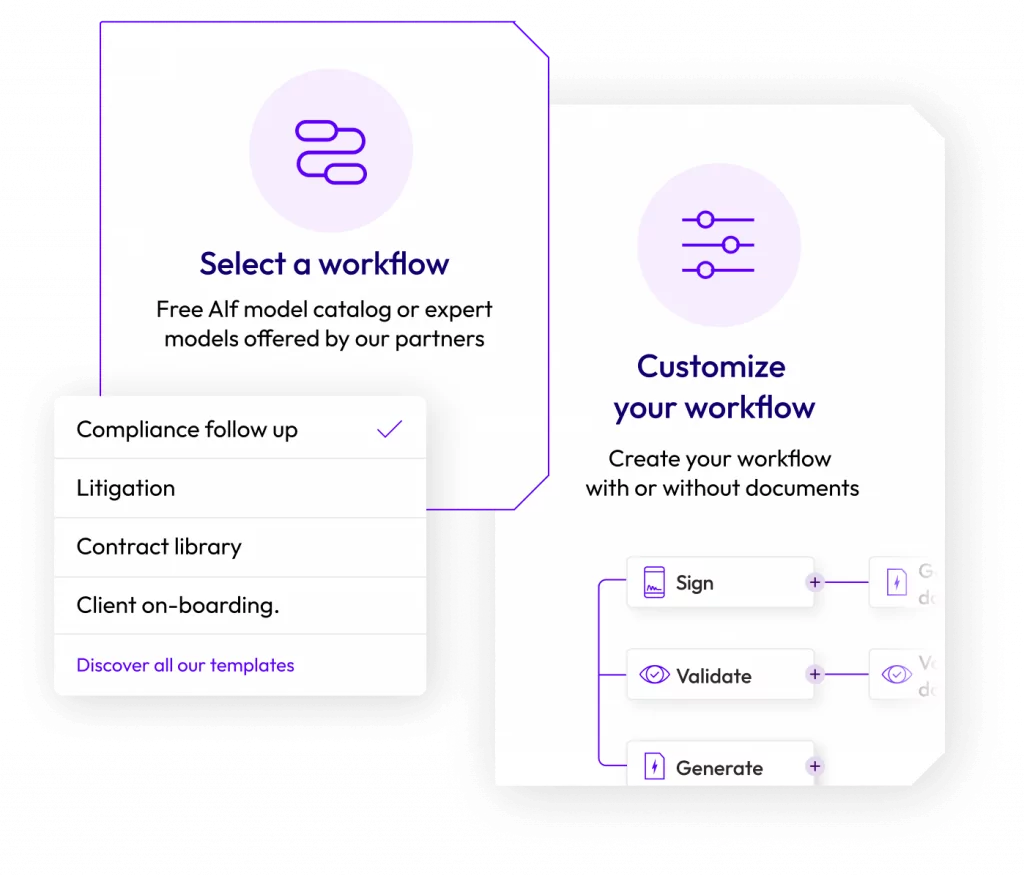
Alf is designed to give a global legal department a single operating layer across its entities and jurisdictions. Features include centralized dossiers and documents, configurable workflows and intake forms, approval circuits, a shared calendar with deadline alerts, a chronological history for each dossier, document generation from templates, electronic signature, role-based access controls, multilingual interface, activity reports and dashboards, and an AI agent that operates within the context of each dossier. Dossiers can be started and connected directly from Outlook. The AI agent knows which entity it is acting for, which information it may use and when a human must review the output, because those rules are part of the operating context, not an afterthought.
That context is what Alf calls Organizational Legal Context: a shared operational layer that tells both humans and AI agents who can do what, on which matter, in which entity, according to which rule and with what level of autonomy. When a new entity joins the group, it joins an existing operating model rather than creating a new silo. When a team member leaves, the knowledge, the decisions and the approval history stay in the system. Alf helps international legal departments run their teams, processes and AI agents as one system. The goal is to scale legal operations without scaling complexity. Organizations including Air France, SNCF, ENGIE Home Services and CCI Paris Ile-de-France use Alf to structure their legal department operations across entities.
How many of your recurring workflows have a named owner and a documented approval rule? Bring one real workflow and walk through it with the Alf team.
Book a demoFrequently asked questions
What is the difference between legal operations and legal department operations?
The two terms are used interchangeably in most organizations. “Legal operations” tends to appear in job titles and industry frameworks such as CLOC Core 12 and the ACC Legal Operations Maturity Model. “Legal department operations” describes the same function from the perspective of the department as a whole: how it organizes its work, its people, its data and its technology to deliver legal services consistently across the business.
The practical distinction, where one exists, is that “legal operations” sometimes refers to a dedicated team or role, while “legal department operations” refers to the broader operating model that the whole department runs on. Both cover intake, matter management, financial management, vendor management, knowledge management, technology and reporting.
What should a legal operations team measure first?
Start with one measure tied to a decision you must make now. If outside counsel spend is hard to explain to leadership, start there. If requests are getting lost between business units, start with matter volume and intake channel. The measure should be specific enough to support a decision, not broad enough to describe the whole department.
Before collecting data, define the matter, entity, business unit and time period. Without those definitions, numbers from different entities or time periods will not be comparable, and the dashboard will show activity without showing anything actionable. A single well-defined measure is more useful than a broad set of metrics that nobody can act on.
When should a legal department build a dedicated legal operations team?
A dedicated role becomes useful when operational work consumes significant legal capacity. Other signals include recurring processes that vary unpredictably by entity or jurisdiction, matter data you cannot trust, outside counsel spend you cannot explain or stalled technology adoption. The trigger is not headcount: it is the point at which the absence of an operational owner is visibly costing the department in service quality, risk control or capacity.
Start with the single costliest gap rather than trying to build every competency at once. A part-time legal operations function focused on one well-defined problem will deliver more value than a broad mandate with no clear priority. Once that gap is closed and the process is documented, the scope can expand.
How does a global legal department keep its operating model consistent across jurisdictions?
Consistency across jurisdictions requires making the operating model explicit rather than relying on informal coordination. For each recurring service, the department should define the requesting entity, the applicable policy, the matter owner, the approval threshold, the escalation route and the location of the final record. Those definitions become the shared framework that regional teams adapt to local requirements rather than reinvent from scratch.
The challenge is that local legal requirements, languages and business practices vary. The operating model should distinguish between what must be uniform across the group and what must be adapted locally. Approval thresholds, data access rules and escalation routes are typically group-level decisions. Template language, local regulatory requirements and jurisdiction-specific review steps are typically local adaptations within the group framework.
How does Alf support legal department operations across multiple entities?
Alf is designed to give a global legal department a single operating layer across its entities and jurisdictions. Each dossier is connected to an entity, a jurisdiction, a named owner and an access group. Workflows and approval circuits are configurable by entity and matter type, so a group policy can apply consistently while local requirements are handled within the same system rather than in a separate process.
The AI agent in Alf operates within the context of each dossier. It knows which entity it is acting for, which information it may use and when a human must review the output. Data is hosted in the European Union, encrypted at rest and in transit, and access is controlled by role with two-factor authentication required. Legal professionals remain responsible for reviewing legal content and decisions.