
Legal Entity Management: Control Across Every Entity
TL;DR
Legal entity management is the discipline of keeping accurate, current and usable records on every legal entity in a group: its identity, ownership, governance, filings and lifecycle from formation to dissolution. For a group operating across multiple jurisdictions, the challenge is not the volume of information but the fragmentation of it. Records sit in spreadsheets, shared folders, email threads and individual memory, with no single governed context linking them. The next step is to map one workflow, such as a foreign qualification or an annual report renewal, entity by entity, with a named owner and a documented approval path.
In this article
How many of your entities can you describe accurately without opening three different systems? In most groups, the answer depends on who remembers the details. A board resolution sits in one folder, registered agent information in a spreadsheet, a filing deadline in someone’s inbox. Nothing links them, and the gap between what the group owns and what the legal department can reliably see grows with every new subsidiary or jurisdiction.
Legal entity management is the discipline that closes that gap. This article explains what it covers, what a practical record looks like, how jurisdictional obligations shape the work, and what an operating model needs to make the information usable across teams.
What does legal entity management mean?
Legal entity management is the discipline of keeping accurate, current and usable information about every legal entity in a group. It records each entity’s identity and ownership, its governance, its filings and registrations, and its lifecycle from formation to dissolution. The goal is not a static directory of company names. It is a governed record that answers operational questions: who controls this entity, who may act for it, what it still must do, and where the evidence of past decisions is kept.
A parent company, a subsidiary, a branch, a joint venture and a holding company can each carry different rights, obligations and decision-makers. Treating them as one undifferentiated list is where errors begin. Direct ownership identifies the company that holds an interest immediately. Indirect ownership runs through one or more intermediate entities. A group structure therefore needs the full chain of ownership, not only a list of names, because the chain determines who has authority and who bears liability.
Every entity moves through three stages. At formation, the entity is established, registered, given its required representatives, and its organizing documents are recorded. During operation, registrations, governance records, officers, directors, licenses, reports and recurring deadlines are maintained. At closure, the approvals, filings, tax steps and dissolution or withdrawal actions are completed for each relevant jurisdiction. Each stage generates records that the next stage depends on.
What records and responsibilities does it cover?
The record proves what an entity is, who controls it, who may act for it, and what it still must do. A practical entity record links the entity’s legal identity to its ownership, governance, filings, decisions and current status. Without that link, the record is a list of facts rather than a tool for coordination.
A complete entity record typically holds the following categories of information:
- Identity: legal name, entity type, formation date, jurisdiction of formation, registration number, principal address and registered office.
- Ownership: direct owners, indirect owners, percentages or interests, and the entities through which ownership is held.
- People and authority: directors, officers, managers, authorized signatories, the registered agent, and the scope of each role.
- Governance records: minutes, board resolutions, shareholder resolutions, written consents and evidence of approval.
- External obligations: annual reports, filings, licenses, renewals, certificates and other jurisdiction-specific requirements.
The most important control is the link between a decision and the entity that owns it. A contract approval, a capital increase, an appointment or a litigation instruction may require a specific signatory, board, shareholder or local officer. The record should show who acted, under what authority, and on what date. It should also show where the final document is kept. Without that link, the record cannot support a governance review, a due diligence process or a regulatory inquiry.
Responsibility for maintaining these records is rarely concentrated in one team. The legal department defines authority, approvals and escalation rules. Legal operations often coordinates the system and the workflows. Corporate secretarial teams maintain governance records. Local teams supply jurisdiction-specific facts. The operating model needs to make those responsibilities explicit, not leave them to informal memory.
How do jurisdictional obligations shape the work?
Jurisdictional obligations multiply the volume and the complexity of entity management. Each jurisdiction where a group operates may impose its own registration requirements, filing deadlines, governance rules and consequences for non-compliance. The work is not uniform, and a model that treats all jurisdictions identically will miss the differences that matter most.
In the United States, entity management is state by state. An entity is domestic in the state where it is formed and becomes a foreign entity in every other state where it does business, requiring a separate registration in each of those states. A Delaware corporation that operates in New York, Texas and California carries four distinct sets of obligations: one as a domestic entity in Delaware and one as a foreign entity in each operating state. Each registration creates its own record, responsible party, deadline and possible consequence for a missed step.
Requirements vary by state and by entity type. In Delaware, for example, domestic corporations and foreign corporations file on different schedules. A missed filing can bring penalties, loss of good standing or administrative consequences. The exact result depends on the applicable state rules. The same principle applies across European jurisdictions, where annual filings, governance requirements and disclosure obligations differ by country and by entity type.
The practical implication is that a group cannot manage jurisdictional obligations from a single template. Each obligation needs a named owner, a documented deadline, a clear approval path and a record of completion. The operating model must make those four elements visible for every entity in every jurisdiction where the group operates.
Is entity information scattered across systems in your group? Map one real workflow with the Alf team, entity by entity.
Talk to an expertWhat should entity management software support?
Entity management software should maintain one central record for entity data, documents, responsibilities, deadlines and governance history. Its purpose is to make the source of truth easier to maintain and easier to access across teams. It should not flatten the differences between entities and jurisdictions or create the illusion that a single interface resolves the underlying complexity.
The capabilities that matter for a group legal department include:
- Entity records: legal names, identifiers, addresses, ownership, officers, directors, agents and jurisdiction data kept in one controlled location, with a chronological history of changes.
- Calendars and alerts: annual reports, renewals, licenses, certificates and other deadlines tracked by entity and jurisdiction, with named owners for each obligation.
- Access and reporting: permissions assigned by user, group or matter, and activity reports that give legal operations and management visibility across the portfolio.
- Document links: formation documents, governance records, completed filings and approvals attached to the entity record they belong to, not stored in a separate folder system.
Software and services are different choices that address different needs. A corporate services provider may act as registered agent, prepare filings or support local administration in a jurisdiction where the group lacks internal capacity. Software gives the legal department a system for its own records and workflows. The two can coexist, but the operating model still needs clear ownership, approvals and escalation rules. Software can hold the record; it cannot decide who owns each filing or who signs for each entity. Those answers need to be settled before a tool is selected.
The issue is not effort. It is the absence of a governed context.
Most groups already have the information needed to manage their entities. Formation documents exist. Deadlines are known. Officers are on record somewhere. The problem is that the information is distributed across spreadsheets, shared folders, email threads, local tools and individual memory, with no single system linking a decision to the entity that owns it, the person who approved it and the document that proves it.
A coordinated operating model does not require more information. It requires that the information already held becomes findable, attributable and auditable by anyone with the right access, not only by the person who remembers where it was saved.
What does a coordinated operating model solve?
Fragmentation in legal entity management is a structural problem, not a talent problem. The information exists. The deadlines are known. The people responsible are identifiable. What is missing is a governed context where the work happens consistently, where a new team member can find the same answer as the one who has been managing the entity for three years, and where a missed step is visible before it becomes a consequence.
A useful operating model answers four questions for each obligation. First, responsibility: which named role, team or external provider owns the obligation. Second, approval: who validates a filing, appointment, resolution or exception. Third, escalation: what happens when a local deadline, a missing document or an ownership discrepancy creates risk. Fourth, history: the decision, its supporting documents, the approval and the final action, kept together and accessible.
Consider a group with subsidiaries in several European countries and a US holding structure. A foreign qualification deadline arrives for the Texas entity. Under a fragmented model, the deadline may sit in a spreadsheet that one person maintains, the registered agent details may be in a separate folder, and the approval for the filing may require an email chain that takes longer than the deadline allows. Under a coordinated model, the obligation is linked to the entity record, the owner is named, the approval path is documented, and the completed filing is attached to the record when done.
The same logic applies to governance decisions. When a board resolution authorizes a capital increase in a subsidiary, the record should link the resolution to the entity, the signatory, the date and the resulting document. When that entity is later involved in a due diligence process or a regulatory inquiry, the answer is in the record, not in the memory of the lawyer who handled it.
A collection of tools is not an operating model. The goal is not to add another system to the stack. It is to make the existing information governed, attributable and usable across the teams and jurisdictions where the group operates.
How Alf supports legal entity management
Alf is the operating infrastructure for global legal departments: it connects people, processes, knowledge and AI agents in one governed system. For legal entity management, that means linking entity records, governance decisions, filing deadlines and approval workflows in a single context that works across entities and jurisdictions.
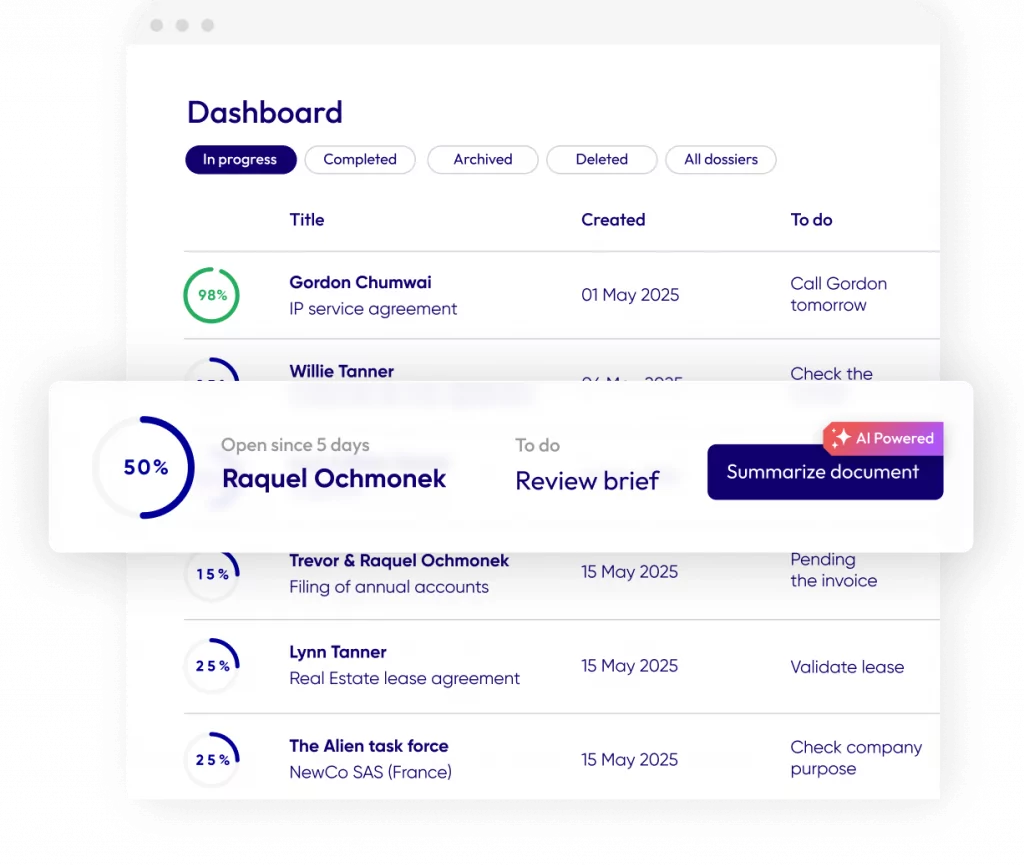
Alf is designed to give each entity its own dossier, where formation documents, governance records, completed filings, upcoming deadlines and approval history are held together. Features include configurable workflows and forms, shared calendars with deadline alerts, access rights by user or group, a chronological history of each dossier, and activity reports for legal operations and management. Dossiers can be started and connected directly from Outlook, and documents can be generated from Alf templates based on Word. Electronic signature is supported through DocuSign.
The mechanism that makes this work across a group is what Alf calls Organizational Legal Context: a shared operational context that tells people and AI agents who can do what, for which entity, under which rule, and with what level of autonomy. When an AI agent is involved in drafting or reviewing a document, it operates within that context. Validations and decisions are logged, which makes it possible to respond when a regulator, a client or leadership asks how a matter was handled.
Alf is built to scale legal operations without scaling complexity. A new entity joins the existing model. A new jurisdiction adds its obligations to the same governed system. The group grows without requiring the legal department to rebuild its operating model from scratch each time. Legal departments including Air France, SNCF, ENGIE Home Services and CCI Paris Ile-de-France use Alf to run their teams, processes and AI agents as one system. The starting point is one workflow: map the entity, the jurisdiction, the required document, the owner, the approval, the deadline and the final record. Then check whether everyone involved can find the documented answer without relying on the person who remembers how it was done last year.
How many filing deadlines in your group have a named owner and a documented approval path? Bring one entity and walk through it with the Alf team.
Book a demoFrequently asked questions
What is legal entity management and why does it matter for a group?
Legal entity management is the discipline of keeping accurate, current and usable records on every legal entity in a group: its identity, ownership, governance, filings and lifecycle from formation to dissolution. It matters because a group cannot govern what it cannot see. When entity information is scattered across spreadsheets, shared folders and individual memory, the legal department cannot reliably answer who controls an entity, who may act for it, or what obligations it still must meet.
For a group operating across multiple jurisdictions, the stakes are higher. Each jurisdiction may impose its own registration requirements, filing deadlines and governance rules. A missed filing or an undocumented governance decision can create consequences that are disproportionate to the effort required to prevent them. Legal entity management provides the governed context that makes those obligations visible and attributable.
How often should entity records be reviewed?
Entity records should be reviewed whenever something changes them or a deadline depends on them. At minimum, a record should be updated after formation, any change in ownership or officers, an address change, a new jurisdiction registration, a completed filing, or an approved governance decision. Waiting for an annual review cycle means that the record is out of date for most of the year.
A practical approach is to link the review trigger to the event rather than to a calendar date. When a board resolution is approved, the record is updated. When a registered agent changes, the record reflects it immediately. This keeps the record usable as a working tool rather than a periodic report.
Who is responsible for legal entity management inside a group?
Responsibility is rarely concentrated in one team, and the right answer depends on the group’s operating model. The legal department typically defines authority, approvals and escalation rules. Legal operations often coordinates the system and the workflows. Corporate secretarial teams maintain governance records. Local teams supply jurisdiction-specific facts and handle filings that require local knowledge or local presence.
The operating model needs to make those responsibilities explicit for each entity and each obligation. When responsibility is left to informal memory, the answer changes depending on who is asked. A named owner for each obligation, with a documented approval path and an escalation rule, is the minimum structure that makes coordination reliable across a group.
Does the approach to legal entity management differ by jurisdiction?
Yes, significantly. Each jurisdiction imposes its own registration requirements, filing deadlines, governance rules and consequences for non-compliance. In the United States, entity management is state by state: an entity is domestic in its formation state and must register separately as a foreign entity in each state where it does business. In Europe, annual filing obligations, disclosure requirements and governance rules differ by country and by entity type.
A group operating across multiple jurisdictions cannot apply a single template to all entities. Each obligation needs to be mapped to the applicable local rules, with a named owner and a documented deadline. The operating model must accommodate those differences without requiring a separate system for each jurisdiction.
How does Alf support legal entity management across multiple entities and jurisdictions?
Alf is designed to give each entity its own dossier, where formation documents, governance records, completed filings, upcoming deadlines and approval history are held together in one governed system. Configurable workflows and forms allow the legal department to structure the work according to its own rules, without requiring code changes. Access rights can be set by user, group or dossier, so each team sees what is relevant to them.
The system is built to work across entities and jurisdictions as one operating model. When a new entity is added, it joins the existing structure rather than requiring a separate setup. Validations and decisions are logged, which supports governance reviews and makes it possible to respond when a regulator or leadership asks how a matter was handled. Legal judgment and final decisions remain with the responsible professionals.