
Legal Operations Management: Build the Operating Model
TL;DR
Legal operations management is the set of processes, roles, data and technology that allow an in-house legal department to deliver its work consistently, with ownership, approvals and decisions made explicit. For a group operating across multiple entities and jurisdictions, the challenge is not finding capable people: it is making the operating model visible enough that work can be routed, tracked and governed without depending on individual memory. The right starting point is not a tool selection. It is mapping one recurring request end to end and identifying where ownership, approval and the final decision are currently unclear.
In this article
What is legal operations management?
Legal operations management is the discipline that brings business and operational rigor to how an in-house legal department delivers its work. It covers the processes, roles, data and technology that determine how legal work is requested, assigned, tracked, approved and reported on. Where legal practice focuses on advice, judgment and representation, legal operations focuses on the system in which that practice runs: who owns each matter, who can act, who approves, and where the final decision is recorded.
The distinction matters most in a group with several entities and jurisdictions. Consider a request that arrives from a subsidiary in Germany. The local business team works from one version of a policy, the regional legal team from another, and an outside counsel opinion sits buried in an email thread from six months ago. The matter needs an owner, a risk threshold, an approval path and a record of the final decision. Legal operations management is the function that makes all of that explicit before the next request arrives.
The function usually sits inside the General Counsel’s organization, reporting to the General Counsel, a Chief Operating Officer for Legal, or a Director of Legal Operations. Its scope touches legal priorities, resources, technology and service delivery, which is why it belongs close to the people who set those priorities.
What does the function cover?
The CLOC Core 12 gives legal departments a shared map of what legal operations covers. The twelve capability areas include financial management, practice operations, service delivery models, technology, knowledge management, information governance, project and program management, and training and development. Not every department needs all twelve at the same level of maturity. The ACC Legal Operations Maturity Model at acc.com/maturity offers a structured way to assess where a department stands and where to focus next.
In practice, the function serves four department-level goals. First, service delivery: routing work to the right internal team, outside counsel, or alternative provider based on matter type, risk and jurisdiction. Second, financial control: planning budgets, tracking spend against plan, collecting forecasts and reviewing outside counsel invoices. Third, visibility: giving the General Counsel reliable information on matters, spend, risk and performance across the group. Fourth, improvement: running the projects that change processes, technology or team responsibilities in a way that holds.
The scope of the function grows with the department. A single legal operations manager may cover finance, vendors, technology and reporting in a smaller group. As the department matures, specialists can be added over time. The right structure is the one that matches the operating problem, not a standard headcount model borrowed from another organization.
What does a legal operations manager do?
A legal operations manager runs the management side of the legal department. The work starts with financial control: building the legal budget, tracking actual spend against plan, collecting forecasts and accruals, and giving the General Counsel a clear view of internal and external costs. Outside counsel spend should be linked to matters, budgets, firms, jurisdictions and work types, so that the data can answer management questions rather than just record transactions.
Technology and process improvement are closely connected in this role. When a recurring problem surfaces, the manager’s job is to map the current workflow, identify where ownership and approvals are missing, define the data and permissions required, and then select or configure a tool that supports the corrected process. Implementation does not end at launch: adoption, data quality, workflow exceptions and reporting accuracy all need ongoing attention. A tool that is not used consistently does not produce reliable management data.
The role requires financial judgment, process design, project management, data literacy and the ability to work across functions. Legal experience is useful but not the only path into the role. Experience in business operations, finance, procurement, analytics or change management is equally relevant. What matters most is the ability to make the operating model legible to the people who work inside it: attorneys, paralegals, business stakeholders, finance, and increasingly, AI agents.
Authority in this role must be explicit. A legal operations manager may recommend a technology investment without holding approval authority. A manager may monitor outside counsel spend without deciding which firm handles a high-risk matter. The operating model should state who recommends, who approves, who performs and who owns the result. Leaving those lines implicit is one of the most common reasons legal operations initiatives stall.
Is ownership of legal work unclear across your entities? Map one recurring request end to end with the Alf team, entity by entity, and identify where the first structural fix belongs.
Talk to an expertHow to build a legal department operating model
A legal department operating model sets out how the function delivers legal work, from intake to reporting. Building it means making four things explicit: how work enters the legal department, how it is assigned and tracked, how decisions are approved and recorded, and how performance is measured and reported to leadership.
Matter intake and assignment
Matter intake is the entry point for legal work. A useful intake record captures the requesting business unit, entity, jurisdiction, matter type, urgency, risk indicators, relevant documents and the requested outcome. Without a structured intake, triage decisions are made informally, ownership is assumed rather than assigned, and the same information gets collected multiple times by different people.
Triage decides three things: priority, ownership and the level of review required. A low-risk, routine request may follow a standard workflow. A cross-border dispute, a regulatory inquiry or a sensitive matter may need a senior attorney and a specific approval threshold. Some matters require outside counsel. The operating model should define those thresholds in advance, so that triage is a decision supported by rules rather than a judgment made from scratch each time.
The assignment decision should answer four questions consistently. Who owns the matter: one accountable legal lead, with supporting roles named. Who can act: attorneys, paralegals, business users, vendors or AI agents, within defined permissions. Who approves: the person responsible for the relevant risk, spend, policy exception or business commitment. Where the record lives: one matter history holding requests, decisions, documents, approvals and changes, accessible to the people who need it and protected from those who do not.
The operating model question that matters most
Before selecting a tool or deploying an AI agent, identify one recurring request in your department and trace it end to end. Mark every point where the owner is unclear, where the approval path is informal, and where the final decision is not recorded anywhere. That single map tells you where the first structural fix belongs. It also tells you whether the problem is a process gap or an information gap, and that distinction determines what kind of solution will actually hold.
A collection of tools is not an operating model. The operating model comes first: who owns what, on which entity, under which rule, with what level of autonomy. Tools and AI agents can then be configured to support that model rather than work around it.
Metrics that answer management questions
A useful metric is one that answers a management question. How much outside spend is committed, forecast and paid, by matter? Which matters are over budget or missing a current forecast? Which matters are still open without a named owner or a next action? These questions require data that is collected consistently, linked to the right matter and entity, and available in a format the General Counsel can use without manual assembly.
Defining metrics before selecting a reporting tool forces clarity about what data needs to be captured at intake and throughout the matter lifecycle. Departments that start with a reporting tool and work backward often find that the underlying data is too inconsistent to support the reports they want. The operating model determines what data exists. The reporting tool surfaces it.
How does legal technology fit in?
Legal technology supports connected workflows and management data. It does not replace the operating model. The tools that legal operations teams typically work with include matter management, contract management, document management, knowledge management, electronic signatures, legal holds, workflow automation and business intelligence. Each category addresses a specific operational need, and the right selection depends on which problem the department is trying to solve first.
Start selection with the problem, not the feature list. Which data does the department need to manage the work? Who will use the tool, and in which entities? What controls must it support, and which systems must it exchange information with? A tool that solves the right problem for the people who will actually use it produces better outcomes than a comprehensive platform that requires significant configuration before it reflects how the department works.
The choice between in-house delivery, outside counsel and alternative providers should be supported by data: expertise, urgency, jurisdiction, capacity, confidentiality, cost and risk. Legal operations management provides that data and keeps it linked to the matters and entities it describes. That is what makes the choice a governed decision rather than an informal one.
AI agents are entering legal workflows. The question is not whether to use them but how to govern them. An AI agent that operates without knowing which entity it is working on, which policy applies, or at what threshold a human must review its output introduces risk rather than reducing it. The operating model must define what an agent can do, on which data, up to which threshold, and when a human takes over. That context has to be explicit before the agent is deployed, not discovered after the first exception.
Alf
Alf is the operating infrastructure for global legal departments: it connects people, processes, knowledge and AI agents in one governed system. For a legal department managing work across multiple entities and jurisdictions, Alf is designed to make the operating model explicit and operational rather than documented and ignored.
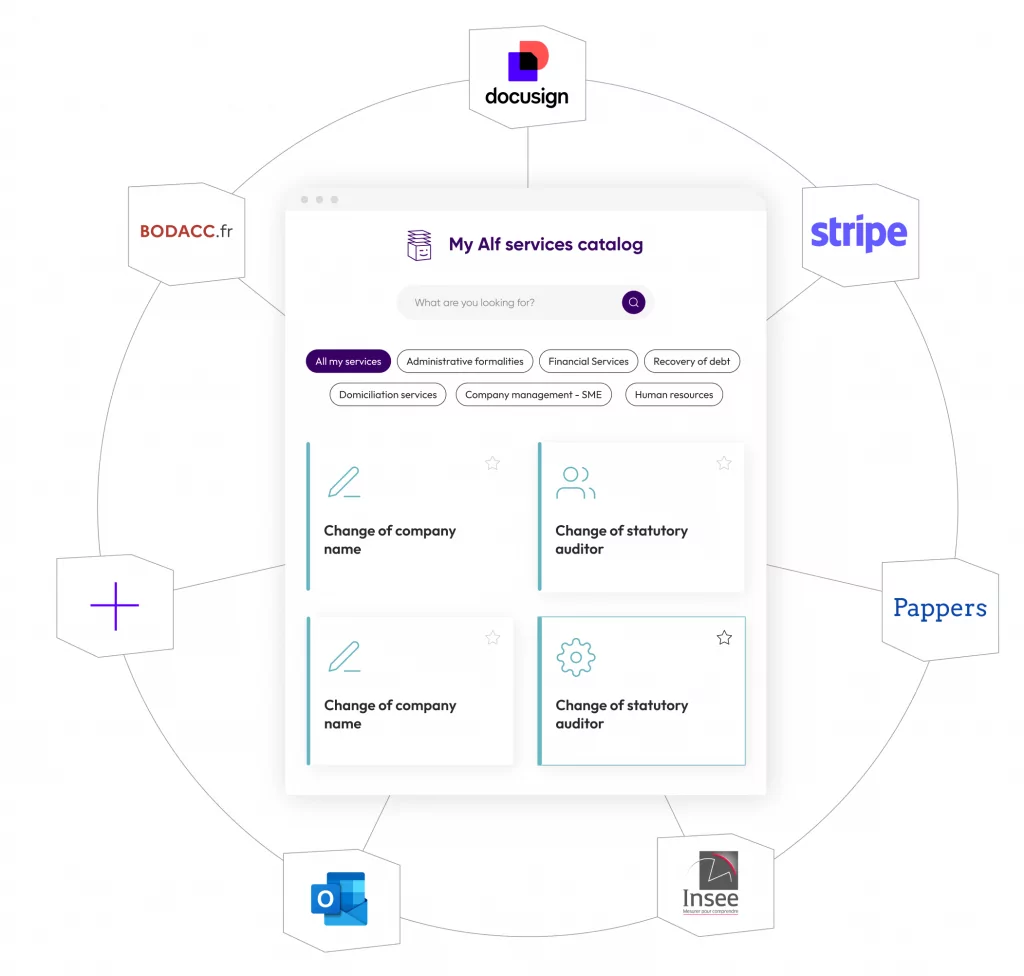
Alf’s features include centralizing dossiers and documents, configuring workflows and forms without code, routing approval circuits, maintaining a chronological history of each dossier, controlling access by user, group or dossier, generating documents from Word templates, handling electronic signatures through DocuSign, and giving an AI agent the context of the dossier it is working on. Dossiers can be started and connected directly from Outlook. Activity reports and dashboards give the General Counsel a consolidated view across the group.
The Organizational Legal Context in Alf is a shared operational context that tells both humans and AI agents who can do what, on which matter, in which entity, under which rule and with what level of autonomy. That context is what allows a new entity to join the existing operating model rather than build its own. It is also what makes it possible to respond when a regulator, a client or leadership asks how AI was used on a matter: validations and decisions are logged. Legal departments that use Alf include Air France, SNCF, ENGIE Home Services and CCI Paris Ile-de-France.
The issue is not that legal departments lack capable people or good tools. It is that the operating model has never been made explicit enough to scale. Alf is built to help international legal departments run their teams, processes and AI agents as one system, so that complexity does not grow every time the business does.
Do approval paths in your group depend on who happens to be available? Bring one real matter type and walk through it with the Alf team, entity by entity.
Book a demoFrequently asked questions
What is legal operations management?
Legal operations management is the discipline that brings operational and business rigor to how an in-house legal department delivers its work. It covers the processes, roles, data and technology that determine how legal work is requested, assigned, tracked, approved and reported on across entities and jurisdictions.
The function is distinct from legal practice. Where attorneys focus on advice, judgment and representation, legal operations focuses on the system in which that practice runs: service delivery, financial control, visibility for leadership, and the improvement projects that change how the department works over time.
What does a legal operations manager do?
A legal operations manager coordinates the management side of the legal department. Core responsibilities include building and tracking the legal budget, monitoring outside counsel spend by matter and jurisdiction, owning technology selection and implementation, and running process improvement projects. The role also involves producing the reporting that gives the General Counsel a reliable view of matters, spend and performance.
The role grows with the department. It often starts with spend tracking and vendor management, then expands into technology ownership, data governance and, increasingly, the governance of AI agents operating within legal workflows. Authority in the role must be explicit: the operating model should state what the manager can recommend, approve and decide independently.
How does legal operations management differ across jurisdictions?
The core discipline is consistent: make ownership, approvals and decisions explicit, and connect them to the right data. What varies by jurisdiction is the legal and regulatory context that shapes the rules embedded in the operating model. Approval thresholds, data handling requirements, outside counsel relationships and reporting obligations may all differ between entities in different countries.
For a group operating across multiple jurisdictions, the operating model needs to accommodate both group-level policies and local requirements. That means defining which rules apply at the group level, which are set locally, and how exceptions are escalated and recorded. A single operating model that ignores local variation creates compliance gaps. A model that fragments entirely by jurisdiction makes group-level governance impossible.
Where should a legal department start with legal operations?
Start with one recurring request and trace it end to end. Identify every point where the owner is unclear, where the approval path is informal, and where the final decision is not recorded anywhere. That map tells you whether the problem is a process gap, an information gap or a technology gap, and that distinction determines what kind of solution will hold.
The CLOC Core 12 framework and the ACC Legal Operations Maturity Model both offer structured ways to assess where a department stands across capability areas. Picking the capability most visibly connected to a problem the team can already see, such as unforecastable outside counsel spend or email-based intake with missing information, produces faster traction than trying to build all capabilities at once.
How does Alf support legal operations management?
Alf is designed to make the operating model of a legal department explicit and operational across entities and jurisdictions. Its features include configurable workflows and approval circuits, centralized dossiers with chronological history, access controls by user or group, document generation from templates, electronic signatures, and an AI agent that operates with the context of the dossier it is working on. Dossiers can be started directly from Outlook, and dashboards give the General Counsel a consolidated view across the group.
Alf is not a legal AI tool that extends what a single lawyer can do. It is the infrastructure that organizes how the legal department works as a whole: who owns what, on which entity, under which rule, with what level of autonomy. That context is what allows AI agents to operate within governed boundaries and what makes it possible to demonstrate, when asked, how a matter was handled and by whom.
Ready to make your operating model explicit? Walk through one real workflow with the Alf team and see where structure can replace informal coordination.
Book a demo