
Legal Spend Management: A Control Framework for Legal Departments
TL;DR
Legal spend management is the full process of planning, assigning, approving, tracking, and analyzing legal costs across internal and external sources. Invoice review is one control inside that process, not the process itself. For a group operating across multiple entities and jurisdictions, control depends on matter data, outside counsel guidelines, budgets, accruals, and approvals all pointing to the same matter record. The next step is to decide who owns that record and where each exception decision is kept.
In this article
- Legal spend management covers the department’s full cost picture
- Outside counsel controls connect guidelines, budgets, and invoices
- Budgets and reporting turn legal costs into decisions
- Software supports the workflow, but ownership determines its value
- What makes legal spend management sustainable?
- How Alf supports legal spend management
- Frequently asked questions
A subsidiary has already engaged outside counsel. The business unit expects a forecast. Finance needs an accrual. The legal department still has to review the invoice. Each step is straightforward on its own. Together, they rarely fit into a single coherent process. Legal spend management gives that sequence a structure across internal and external costs, entities, jurisdictions, matters, and firms.
This article explains what legal spend management covers, how the controls connect, and what a group operating across multiple entities needs to put in place before adding more tools or rules.
Legal spend management covers the department’s full cost picture
Legal spend management is a department-wide discipline. It covers how a legal department reviews, tracks, analyzes, forecasts, and reports legal costs. That scope includes both internal and external spending: outside counsel fees, litigation expenses, settlements, internal operations, legal technology, and other purchased services. Invoice review checks whether a bill follows an agreement. Matter management organizes the legal work itself. Spend management brings both together and answers a financial question: what is committed, what is spent, what comes next, and who owns the change when numbers move.
Spend categories need a clear owner
Most legal departments need to separate at least two cost groups: internal costs, which include employee compensation, benefits, travel, training, and department operations; and external costs, which include law firms, alternative legal service providers (ALSPs), experts, e-discovery, filing fees, and other matter-related vendors. Allocation can follow the requesting entity, the entity exposed to the risk, the receiving business unit, or a shared rule. Consistency matters more than the choice itself. If one team tags a matter by business unit and another tags a similar matter by legal entity, the two cannot be compared at the group level.
Matter data creates financial data
Each stage of a matter produces information that feeds spend management. At intake, the relevant data points are entity, jurisdiction, matter type, owner, business sponsor, and expected legal support. At engagement, they are firm, timekeepers, rates, billing terms, budget, and approval authority. The financial record then captures work in progress, invoices, accruals, scope changes, and final outcome. This history supports sourcing decisions. A legal department can compare firms by matter type, jurisdiction, phase, staffing, rate movement, budget variance, and invoice exceptions, and then decide whether to keep preferred counsel, renegotiate fees, bring work in-house, or move a portfolio to another provider.
Outside counsel controls connect guidelines, budgets, and invoices
Outside counsel controls work when terms, billing guidelines, budgets, invoices, and approvals all point to the same matter record. A guideline stored only in a PDF gives reviewers something to read. It does not give them a reliable way to apply the rule consistently across entities or over time. The control should capture the entity, jurisdiction, matter owner, and approved firm; permitted timekeepers, negotiated rates, and staffing expectations; billing codes and the budget period; the invoice approver and the escalation path; and who can approve an exception and where that decision is stored. This is the difference between a policy and an operating model.
Fee models change the forecast
The billing structure a legal department agrees with outside counsel directly shapes how predictable its spend will be. Hourly billing shows time, task, and timekeeper in detail, but its final cost still moves with scope, staffing, duration, and rate changes. Fixed fees give a set price for a matter, phase, or service, and that price holds only if the covered work is described clearly. Contingency, success, or risk-sharing arrangements link the fee to an outcome or milestone, which makes forecasting less predictable until that trigger is reached. Each model requires different controls and different data to manage effectively.
| Control point | Hourly billing | Fixed or phase-based fee | Contingency or risk-sharing fee |
|---|---|---|---|
| Price basis | Timekeeper rates multiplied by recorded time | Agreed amount for defined work | Fee linked to outcome, milestone, or shared risk |
| Forecast value | Detailed, but sensitive to scope and staffing | More predictable within the defined scope | Less predictable until the outcome is reached |
| Data required | Rates, timekeepers, hours, tasks, and expenses | Scope, phases, deliverables, and change rules | Outcome definition, payment trigger, and expense treatment |
| Main control | Rate, staffing, task, and time review | Scope change and phase approval | Outcome measurement and agreement review |
| Useful situation | Work with uncertain volume or changing demands | Repeatable work or a defined phase | Matters where parties can define risk and results |
Accruals and exceptions need a routine
Accrual collection requires a regular cadence. Ask each firm for unbilled work and an estimate of next-period spend. The matter owner checks the explanation against the budget and case developments, and the approved figure then goes through Finance. Keeping legal fees, expenses, and settlement exposure separate at this stage makes the accounting treatment cleaner and the comparison across periods more reliable.
Invoice exceptions need a defined route. The reviewer can approve the bill, reject a line, request a correction, or escalate a dispute to the matter owner. Recording the reason, the decision maker, the date, and the final treatment stops the same exception from returning in the next cycle and gives the department a basis for renegotiating billing terms with a firm.
Is outside counsel spend scattered across entities in your group? Map one real outside counsel workflow with the Alf team, entity by entity, from budget owner to exception record.
Talk to an expertBudgets and reporting turn legal costs into decisions
A legal budget is useful when it shows the work, the assumptions, the period, the staffing, and the approval conditions behind the amount. A single annual figure cannot explain why it went over. The cause might be new risk, weak scoping, different staffing, or a strategic choice that was approved deliberately. Without that context, Finance and leadership cannot distinguish a cost overrun from a deliberate investment.
Forecasting combines approved budgets, actual invoices, unbilled work, expected phases, recurring spend, and known changes in demand. The assumption behind each material change should be visible. “Forecast increased” tells a reader very little. “Discovery expanded in the matter, two additional timekeepers were approved, and the next phase moved into the following quarter” supports a decision. The same principle applies to favorable movements: if spend is tracking below budget, the reason matters as much as the number.
Reporting requires defined measures
A report is comparable across periods and entities only when each measure is defined before the data is collected. Useful measures for a group legal department include total spend, external and internal spend separately, budget variance, invoice cycle time, accrual accuracy, rate movement, exception value, and spend by entity or jurisdiction. Each measure needs a clear calculation and a named owner. Without that, two teams can report the same metric differently and produce numbers that cannot be consolidated at the group level.
The issue is not the data. It is the structure behind it.
Legal departments that struggle to produce reliable spend reports often have the underlying data. The problem is that it lives in different systems, tagged differently by different teams, with no shared definition of what a matter, an entity, or an exception means for reporting purposes. Standardizing the data model before selecting a reporting tool is the step most often skipped and most often regretted.
A collection of tools is not an operating model. The controls that make legal spend management work are organizational before they are technological: who owns the matter record, who approves the exception, and where that decision is stored.
Software supports the workflow, but ownership determines its value
The right software connects intake, matter records, budgets, accruals, invoices, approvals, reporting, and accounts payable. It keeps context intact so that each step stays linked to the one before it. It should handle structured data, configurable roles, audit history, permissions, and exports that Finance can use directly. It should also make it possible to trace a reported figure back to the approval behind it.
Selection should start with the operating model, not a feature list. The relevant questions are whether the tool can represent multiple entities and jurisdictions, link each invoice to a matter and enforce rates and billing rules, record budget revisions and collect accruals, route exceptions and separate user permissions, and connect with matter management and accounts payable processes. Two questions matter as much as any feature: who owns the data model, and who maintains the rules after launch. A tool that no one owns degrades quickly.
What makes legal spend management sustainable?
Sustainable legal spend management starts by measuring control quality, not only savings. The relevant indicators are the share of matters with a named owner and a budget, invoices received through the defined process, bills reviewed against guidelines, accruals submitted on time, exceptions resolved with a recorded decision, and reports built on consistent data. These measures show whether the operating model is working, independent of whether spend went up or down in a given period.
Cost control can come from several levers: improved sourcing and negotiated rates, preferred counsel arrangements with staffing rules, phase budgets and fixed fees for defined work, and bringing suitable work in-house. The right lever depends on the risk and complexity of the matter. Low spend is not automatically a good result. If spend creates rework, missed deadlines, or unmanaged exposure, the control has failed regardless of the invoice total.
Controls need a review cycle. Review them at a fixed interval, and review them again after any material change in the business. The triggers for a review include changes to billing rules, approval thresholds, rate cards, budget periods, reporting definitions, user permissions, and firm performance measures. The operating model should also change when the group adds an entity, enters a new jurisdiction, shifts its sourcing strategy, or introduces AI agents into legal workflows. Legal spend management holds together when every cost has an owner and every approval has a record. Before adding more rules or tools, the department needs to decide who owns the matter record and where each exception decision is kept. The controls depend on that answer.
How Alf supports legal spend management
Alf is the operating infrastructure for global legal departments: it connects people, processes, knowledge and AI agents in one governed system. For legal spend management, that means the matter record, the approval workflow, the document history, and the exception log all live in the same place, linked to the entity and jurisdiction they belong to.
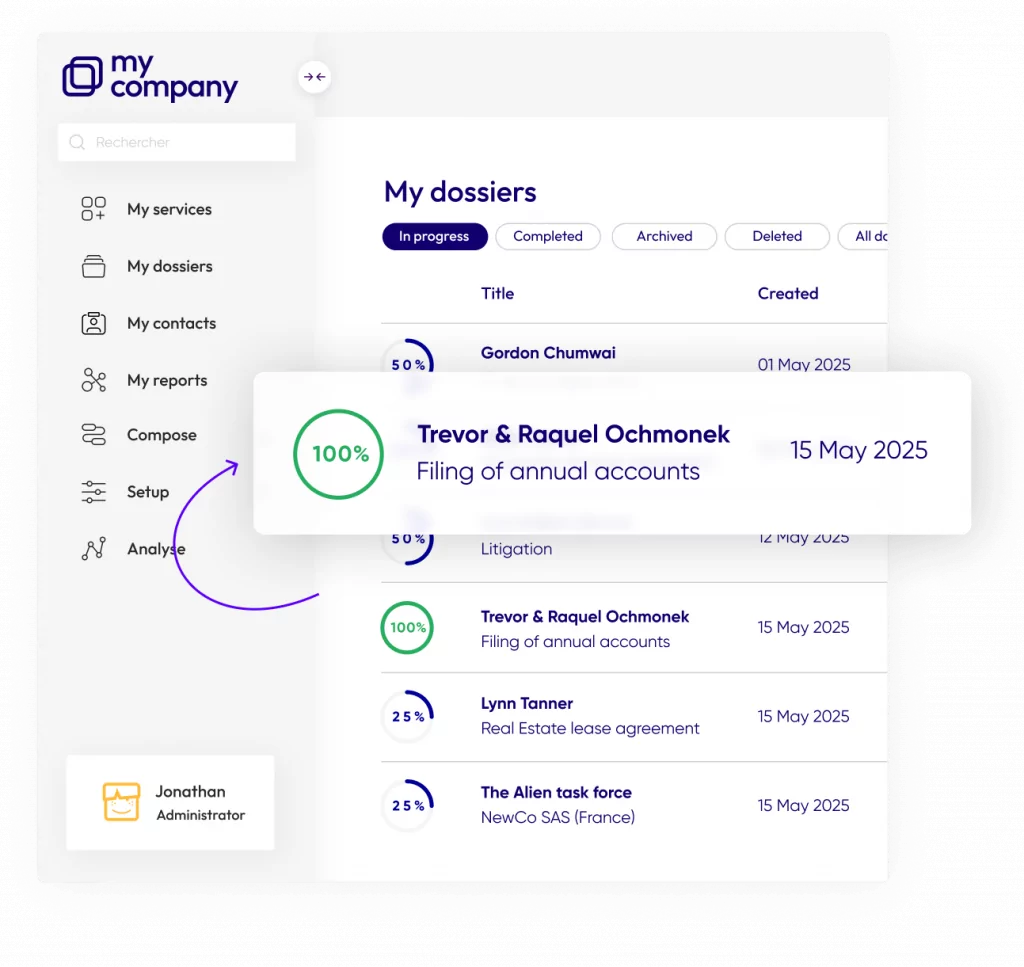
Alf is designed to give a group legal department the structure that makes spend controls work in practice. Features include configurable workflows and forms for matter intake and budget approval, a chronological history for each dossier that captures decisions and exceptions, configurable access rights by user, group, or dossier so that entity-level permissions reflect the group’s actual delegation rules, shared calendars and deadline alerts for accrual and reporting cycles, and activity reports and dashboards that consolidate data across entities. The agent AI operates within the context of each dossier, which means it works with the information that has already been structured and approved rather than in isolation from it. Validations and decisions are logged, which makes it possible to respond when Finance, leadership, or a regulator asks how a cost was authorized or how an exception was handled.
Legal departments including Air France, SNCF, ENGIE Home Services, and CCI Paris Ile-de-France use Alf to run their operations across entities and jurisdictions. The goal is the same in each case: scale legal operations without scaling complexity. When the group adds an entity or changes its sourcing strategy, the operating model extends rather than breaks. The matter record stays the anchor, and the controls stay readable.
How many matters in your group have a named budget owner and a recorded exception log? Bring one real matter type and walk through it with the Alf team, from intake to invoice.
Book a demoFrequently asked questions
Should legal spend management include internal legal salaries?
Yes. Legal spend management covers both internal and external costs. Internal costs include employee compensation, benefits, travel, training, and department operations. Reporting them separately from external costs is important because decisions about internal capacity and decisions about outside counsel require different actions and different approval paths.
The scope needs to be defined before comparing periods or entities. If one region includes internal costs in its spend figures and another excludes them, the comparison will produce numbers that cannot be consolidated at the group level. Consistency in scope matters as much as consistency in calculation.
What is the difference between legal spend management and e-billing?
E-billing is the electronic submission, review, and processing of outside counsel invoices, often using a standard format such as LEDES (Legal Electronic Data Exchange Standard). It is one control point inside legal spend management, focused on whether a bill follows agreed billing rules and rates.
Legal spend management is the broader discipline. It covers planning, budgeting, accruals, matter-level tracking, reporting, sourcing decisions, and the approval workflows that connect all of those steps. A department can have a functioning e-billing process and still lack visibility into committed spend, budget variance, or cost by entity.
Who should own legal spend management in a group legal department?
Legal operations typically owns the process design, data standards, reporting definitions, and day-to-day controls. That includes maintaining billing guidelines, managing the approval workflow, and producing consolidated reports for Finance and leadership. The legal operations manager is usually the person who keeps the operating model coherent across entities.
Matter owners retain responsibility for scope, legal judgment, and budget changes on their specific matters. Finance handles accounting treatment and period close. The Group General Counsel stays accountable for priorities, sourcing strategy, and financial decisions at the department level. Spend management works when those responsibilities are explicit and do not overlap in ways that create gaps in the approval chain.
How does legal spend management change when a group adds a new entity or jurisdiction?
Adding an entity or entering a new jurisdiction introduces new variables: local billing norms, currency, applicable law, local counsel relationships, and potentially different approval thresholds. If the operating model is not updated to reflect these, the new entity will default to informal arrangements that cannot be consolidated or compared with the rest of the group.
The practical steps are to assign a matter owner for the new entity, define which billing guidelines apply, set the approval thresholds and escalation path, and confirm how costs will be tagged for reporting. The sooner those decisions are made explicit, the easier it is to bring the new entity into the group’s existing controls rather than building a parallel process alongside them.
Can Alf support legal spend management for a group operating across multiple entities?
Alf is built to connect matter records, workflows, approvals, and document history across entities and jurisdictions in one governed system. For legal spend management, that means budget approvals, exception decisions, and accrual records are linked to the dossier they belong to, with access rights configured by entity and role. The configurable workflows allow a group to apply its billing guidelines and approval thresholds consistently while accommodating local variations.
Alf does not replace a dedicated e-billing platform or an accounts payable system, but it provides the matter-level context that makes those systems more useful: the record of what was approved, who approved it, and what changed. Legal departments that use Alf can respond to questions from Finance or leadership about how a cost was authorized without reconstructing the decision from emails and spreadsheets.