
What Is Legal Operations: A Guide for In-House Legal Teams
TL;DR
Legal operations is the function inside a corporate legal department that organizes how legal services reach the business: routing, approvals, resources, data, and the decision record. It does not provide legal advice; lawyers assess risk and strategy while legal operations shapes the conditions for that work. For a group operating across multiple entities and jurisdictions, the discipline is less about tools and more about making the rules, responsibilities, and workflows explicit enough to run consistently. The right starting point is mapping one real workflow, end to end, before evaluating any technology.
In this article
- What is legal operations in a corporate legal department?
- What are the twelve operational areas that shape legal operations?
- What does a legal operations manager do?
- How does legal technology support legal operations?
- How are legal operations teams structured in a global group?
- How do you build legal operations around real operating needs?
- Alf and legal operations
- Frequently asked questions
Legal work often stalls for reasons that have nothing to do with the law. A request arrives from a subsidiary. The applicable policy is in one system, the latest exception is in an email, and the lawyer who needs to respond works under a different process in another country. The legal question may be handled well. But there is no reliable way to route the matter, confirm who can decide, track the work, or record the decision. That gap is what legal operations exists to close.
Understanding what legal operations is, and what it is not, matters before any tool is selected or any role is created. The discipline covers more ground than most teams expect, and its value compounds when it is built around the actual structure of the organization rather than a generic framework.
What is legal operations in a corporate legal department?
Legal operations is the function inside a corporate legal department that organizes how legal services reach the business. It uses management practices, processes, data, and technology to deliver consistency, sensible use of resources, and support for the department’s objectives. It does not provide legal substance. Lawyers assess rights, obligations, exposure, and strategy. Legal operations shapes the conditions for that work: how a request enters the department, who receives it, what information is available, which approval applies, and where the final decision is stored.
The distinction from running a law firm matters. A firm manages clients, partners, billing, and matters as a professional services business. A corporate legal operations function serves one company. It supports the in-house team, its internal clients, its entities and jurisdictions, and its relationships with outside counsel. The incentives, the governance, and the accountability structures are fundamentally different.
What are the twelve operational areas that shape legal operations?
The CLOC Core 12 divides legal operations into twelve disciplines: business intelligence, financial management, firm and vendor management, information governance, knowledge management, organization optimization and health, practice operations, project and program management, service delivery models, strategic planning, technology, and training and development. No single team covers all twelve at the same level of maturity, and the ACC Legal Operations Maturity Model offers a structured way to assess where a department stands across each area.
Managing resources, vendors, and information
Business intelligence turns department data into decisions: matter volumes, outside counsel spend, workload distribution, cycle times, and where resources are under pressure. Financial management connects that picture to budgets, forecasts, accruals, and invoices. Together, they give the General Counsel a basis for resource and investment decisions that goes beyond intuition.
Information governance and knowledge management are related but distinct. Information governance controls how data is organized, secured, stored, and shared across the department and its entities. Knowledge management helps people find and use relevant experience: standards, playbooks, templates, precedents, and documented decisions. The first controls the information; the second makes it useful. Both break down quickly in a group where each subsidiary keeps its own records in its own format.
Developing people and service delivery
Service delivery models decide which resource handles which work. A low-risk, recurring request can follow a standard workflow with minimal lawyer involvement. A matter in a sensitive jurisdiction, a high-value transaction, or anything above a defined risk threshold requires a lawyer or senior approval. Legal intake links each request to the right owner, the matter information, the applicable workflow, and the reporting record. Without a defined intake model, the same type of request can take three different routes depending on who receives it first.
Project and program management applies structured methods to legal work: defining scope, assigning responsibilities, tracking dependencies, and making progress visible to the people who need to act. For a group running cross-border transactions or regulatory programs across multiple entities, this discipline is not optional. You can read more about how it applies in practice in the article on legal project management.
What does a legal operations manager do?
A legal operations manager coordinates the practical systems that let the department deliver its work. The role typically covers budgets, outside counsel spend, vendors, technology, workflows, reporting, and process improvement. It sits at the intersection of legal, finance, and technology without belonging fully to any of them. The role is explored in more depth in the article on the legal operations manager.
Responsibilities across budgets and delivery
Process improvement is a large part of the job. It can mean documenting how a request moves from intake to assignment, removing duplicate approvals, setting a standard for matter data, or testing a workflow in one entity before rolling it out across several. The manager coordinates the change. Legal leaders decide the legal policy and the risk position. That boundary matters: legal operations does not replace professional judgment; it creates the conditions for judgment to be applied consistently.
Metrics should answer operational questions: demand, workload, outside counsel spend, approval delays. A metric earns its place only when someone can use it to make a resource, process, or risk decision. Reporting that no one acts on is overhead, not intelligence.
Skills and career paths
Legal operations professionals come from law, finance, project management, data analysis, administration, and technology. The role requires enough legal understanding to respect professional judgment, combined with planning, communication, process design, change management, and comfort with operational data. Titles vary considerably. A coordinator may maintain intake records and schedules. An analyst may prepare reporting and spend analysis. A manager may own several operational disciplines. A director or Head of Legal Operations sets the operating roadmap and advises the General Counsel on capacity, governance, technology, and service delivery.
Is legal work entering your department through too many channels? Map one real intake workflow with the Alf team, entity by entity, to see where routing breaks down.
Talk to an expertHow does legal technology support legal operations?
Legal technology supports legal operations when it helps the department run a defined process, keep reliable information, or make decisions with better context. The categories most commonly used include matter management, electronic billing, document management, contract lifecycle management (CLM), legal intake, workflow automation, legal hold, e-discovery, knowledge management, reporting, and analytics. The category is less important than the operational need it addresses.
Starting with the operational need
Before evaluating any tool, identify the work, the users, the entities, the jurisdictions, the information required, the approval rules, and the record that must remain available. Then check whether existing tools already support that process. A new system is justified only when the gap is real and the existing stack cannot close it. The most common mistake is selecting a tool before the process is defined, which means the tool shapes the process rather than the process shaping the tool.
Security and confidentiality belong in the design from the start. Set access by role or matter, protect sensitive information, define retention rules, and involve security and privacy stakeholders before rollout. A tool does not replace professional review of confidentiality, privilege, or jurisdiction-specific requirements.
Planning for adoption and AI agents
Adoption is the part teams most often underestimate. Assign an owner, document the process, train users, provide support, schedule a review, and track whether the workflow does what it was meant to do. AI agents add more to plan: define what information they can use, what actions they can take, which threshold triggers human review, and where each decision is recorded. An agent operating without that context does not reduce risk; it moves it.
The issue is not the tool. It is the context.
A collection of tools is not an operating model. Legal technology delivers value when it runs on top of explicit rules: who can do what, on which matter, in which entity, under which policy, and with what level of autonomy. Without that layer, each new tool adds coordination overhead rather than reducing it. This is the problem legal operations exists to solve, and it becomes more acute as AI agents take on more of the routine work.
How are legal operations teams structured in a global group?
Legal operations can be run by a single lead, a group of specialists, or a wider team with shared duties. The right structure depends on the department’s geographic spread, matter volume, technology footprint, and outside counsel spend. There is no universal model, and a structure that works for a centralized department often fails when applied to a group with subsidiaries in multiple jurisdictions.
A global department typically splits its work between a central function and local teams. The central group sets the rules: common matter fields, approval thresholds, security standards, and reporting measures. Local teams apply those rules to their own work and flag exceptions. The challenge is keeping the two layers aligned without making the central rules so rigid that local teams work around them. That tension is a design problem, not a people problem.
How do you build legal operations around real operating needs?
Start by mapping how legal work enters, moves through, and leaves the department. Follow one real request from the business team to the final advice, document, approval, or decision. Record the entity, jurisdiction, matter type, applicable policy, responsible role, approval threshold, access rights, exceptions, and final record. That map will expose the gaps more clearly than any survey or benchmark.
What the map usually reveals
The same exercise, run across a few matter types, typically surfaces a consistent set of problems. Requests arrive through several channels with no standard routing. The same matter data gets entered more than once. A local team applies an outdated policy version because no one updated the shared document. An approval depends on personal knowledge of who holds the authority. A deadline is visible to one person but not to the person responsible for the next step. None of these are technology problems. They are organizational problems that technology can support once the rules are explicit.
Assessing needs and setting direction
The General Counsel should sponsor the direction and define what legal operations is authorized to do. That mandate can include setting workflow standards, requesting matter data, coordinating technology requirements, preparing reports, and leading operational projects. Legal judgment, privilege decisions, and legal advice stay with the appropriate legal professionals. That boundary should be stated before any tool is selected, not after.
Testing and scaling the operating model
Once the map is complete and the mandate is clear, the next step is to pick one workflow, make its rules explicit, and test it in one entity before applying it more broadly. The test should answer three questions: does the workflow route work correctly, does the approval record what it needs to record, and do the people using it understand their role in it. Scale what works. Redesign what does not. The goal is a model that a new entity can join without requiring a separate implementation.
Alf and legal operations
Alf is the operating infrastructure for global legal departments: it connects people, processes, knowledge and AI agents in one governed system. It is designed for departments that need to run consistent processes across multiple entities and jurisdictions without building a separate system for each one.
The problem legal operations addresses, making rules, responsibilities, and workflows explicit enough to run reliably, requires more than a document repository or a task tracker. It requires what Alf calls Organizational Legal Context: a shared operational layer that tells both humans and AI agents who can do what, on which matter, in which entity, under which policy, and with what level of autonomy. Without that layer, each new tool or agent operates in isolation, and the coordination overhead grows with every addition.
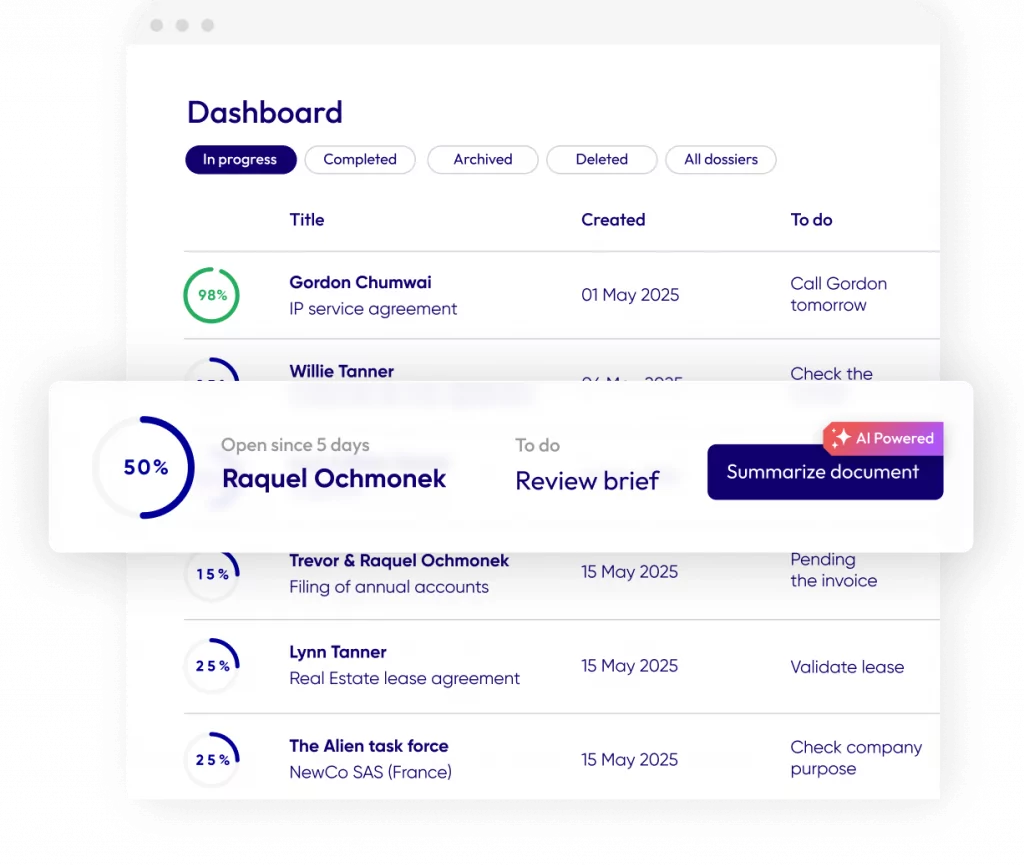
Alf’s features designed to support legal operations include centralizing dossiers and documents, configuring workflows and forms without code, managing approval circuits, tracking deadlines with shared alerts, recording the chronological history of each dossier, setting access rights by user, group, or dossier, generating documents from Alf templates, connecting Outlook to start a dossier directly from an email, and running an AI agent that operates with the context of the dossier rather than in isolation. Validations and decisions are logged, which makes it possible to respond when leadership, a regulator, or a client asks how a matter was handled. Legal departments that have built their operating model on Alf include Air France, SNCF, ENGIE Home Services, and CCI Paris Ile-de-France.
The future of legal is an operating model problem before it is an AI problem. Alf is built to help international legal departments scale legal operations without scaling complexity: one governed system, across entities and jurisdictions, where the group’s policies become workflows that respect local requirements and where a new entity joins the existing model rather than starting from scratch.
Do your approval rules and matter records work the same way across every entity in your group? Bring one real workflow and walk through it with the Alf team.
Book a demoFrequently asked questions
Is legal operations only about legal technology?
No. Technology is one of the twelve disciplines in the CLOC Core 12, alongside financial management, firm and vendor management, knowledge management, and service delivery models, among others. A technology purchase supports legal operations when it addresses a defined need, fits the workflow, and has an owner and an adoption plan. Selecting a tool before the process is defined typically produces more coordination overhead, not less.
The more foundational work is making the rules, responsibilities, and workflows of the department explicit. That work is organizational, not technical. Technology becomes useful once there is something consistent to run on top of.
What is the difference between legal operations and legal advice?
Legal operations organizes how legal services reach the business: routing, approvals, resources, data, and the decision record. It does not assess rights, obligations, exposure, or strategy. Those assessments remain with the lawyers who hold the professional judgment and, where applicable, the privilege.
The distinction matters in practice. A legal operations manager can document the approval workflow for a contract above a certain value. The lawyer decides whether the contract terms are acceptable. Both roles are necessary; neither replaces the other.
How does legal operations work differently across multiple entities and jurisdictions?
In a group with subsidiaries in several countries, the central legal operations function typically sets the common rules: matter fields, approval thresholds, security standards, and reporting measures. Local teams apply those rules to their own work and flag exceptions. The challenge is keeping the two layers aligned without making the central rules so rigid that local teams work around them.
The rules that govern a matter, including which policy applies, who can approve, and what record must be kept, can vary by entity, jurisdiction, or matter type. Legal operations makes those variations explicit and routes work accordingly, rather than assuming a single process applies everywhere.
What should a legal department document first when building legal operations?
Start with one recurring workflow that affects several people, entities, or jurisdictions. Follow a real request from intake to final decision. Record the request source, required information, responsible role, approval rule, exceptions, access rights, and final record. That map will surface the gaps more clearly than any framework applied in the abstract.
The goal of the first exercise is not to design the perfect system. It is to make visible what is currently implicit: who actually decides, where the information actually lives, and what happens when the standard path does not apply. From that map, the next improvement becomes obvious.
How does Alf support legal operations for a group with multiple entities?
Alf is designed to give a global legal department one governed system across its entities and jurisdictions. Its features include configurable workflows and approval circuits, centralized dossiers with chronological history, access rights by user or group, deadline tracking, document generation from Alf templates, and an AI agent that operates with the context of the dossier. The system is designed so that group-level policies become workflows that can accommodate local requirements without requiring a separate setup for each entity.
The underlying principle is that AI agents and legal teams both need organizational context to operate reliably: who can do what, on which matter, in which entity, under which policy, and with what level of autonomy. Alf is built to make that context explicit and to keep it consistent as the group grows.